
-
Publish Your Research/Review Articles in our High Quality Journal for just USD $99*+Taxes( *T&C Apply)
Offer Ends On
Publish Your Research/Review Articles in our High Quality Journal for just USD $99*+Taxes( *T&C Apply)
Offer Ends On
George O. Olorunda* and J. H. Tsado
Corresponding Author: George O. Olorunda, Department of Agricultural Extension and Rural Development, Federal University of Technology Minna, Niger State, Nigeria.
Received: June 14, 2026 ; Revised: June 17, 2026 ; Accepted: June 20, 2026 ; Available Online: June 30, 2026
Citation: Olorunda & Tsado JH. (2026) Adoption of Improved Beehive Technologies and Its Implications for the Income and Welfare of Beekeepers in Ekiti State, Nigeria. J Agric For Meterol Stud, 4(3): 1-5.
Copyrights: ©2026 Olorunda & Tsado JH. This is an open-access article distributed under the terms of the Creative Commons Attribution License, which permits unrestricted use, distribution, and reproduction in any medium, provided the original author and source are credited.
Views & Citations
Likes & Shares
This study investigated how the adoption of improved beehive technologies influences the income and welfare outcomes of beekeepers operating in Ekiti State, Nigeria. Using a four-stage sampling procedure, a total of 249 respondents were selected for participation. Primary data were gathered through semi-structured questionnaires supplemented by oral interview schedules. Analytical tools employed included descriptive measures (frequencies, percentages, and means) as well as inferential techniques, specifically the Gini coefficient and Seemingly Unrelated Regression (SUREG). The Gini coefficient result (GI = 0.70) pointed to a pronounced inequality in earnings among the sampled beekeepers. SUREG estimates revealed that baiting (coeff. = 67,269.73), hive management (coeff. = 410,907.1), honey comb harvesting (coeff. = 26,685.697), and product marketing (coeff. = 14,049.11) each exerted a statistically significant positive effect on beekeeper income. Similarly, baiting (coeff. = 0.993), hive management (coeff. = 2.000), hive monitoring (coeff. = 0.040), and marketing activities (coeff. = 0.027) significantly enhanced welfare status. The three foremost constraints obstructing technology adoption were encroachment and theft by Fulani pastoralists (WM = 2.9), pest and predator pressure (WM = 2.9), and unregulated use of agrochemicals (WM = 2.8). The study recommends that beekeeping cooperatives and relevant stakeholder agencies intensify training programmes focused on the efficient deployment of improved hive technologies so as to optimize income generation and enhance beekeeper welfare.
Keywords: technology adoption; beekeeper income; welfare status; improved beehives; apiculture; Nigeria
INTRODUCTION
Honey bees (Apis mellifera) are eusocial insects that exhibit a complex array of collective defense mechanisms to safeguard the survival of their colonies. Their hives house nutritionally dense reserves of pollen and nectar alongside developing brood, the egg-laying queen, and the worker population — all of which require active protection against a variety of threats. Among such threats are robber bees originating from rival colonies, which typically carry elevated pathogen burdens and pose dual risks of depleting resources and transmitting disease (Kuszewska and Woyciechowski, 2014).
Global food security projections underscore the urgency of expanding agricultural productivity. The Food and Agriculture Organization (FAO, 2009) estimated that meeting the dietary needs of a world population approaching nine billion by 2050 would necessitate increasing total food output by no less than 70 percent. For Nigeria in particular, this challenge demands targeted agricultural development strategies capable of tackling the interconnected problems of poverty, chronic hunger, and malnutrition (Oladimeji et al., 2015).
Apiculture — the deliberate keeping of honey bees for human benefit — is among the oldest documented agricultural pursuits, with archaeological evidence indicating human engagement with bees dating back more than 15,000 years (Tew, 2016). As an enterprise, beekeeping holds distinct advantages for economically vulnerable rural populations, including the landless poor, since it demands minimal land tenure and requires comparatively modest start-up capital. It does not exacerbate existing land-access inequalities, while offering the prospect of rapid income generation within relatively short production cycles (Schouten and Lloyd, 2019). Honey bees further contribute indirectly to wider agricultural productivity through their essential role as crop pollinators, thereby enhancing yields in adjoining farming systems.
In many low- and middle-income countries, apiculture has matured into a dependable livelihood strategy that generates earnings year-round wherever climatic and ecological conditions are suitable. Nigeria, owing to its diverse vegetation zones and favorable weather patterns, is particularly well-positioned to support vibrant beekeeping industries. Beyond honey, commercially relevant hive products include beeswax, propolis, pollen, and royal jelly, all of which can be channeled through established market networks (Van Huis, 2013). According to Aklilu (2002), apiculture constitutes an important subsector within the broader livestock economy and contributes meaningfully to rural livelihoods.
Wider adoption of improved beehive technologies in Nigeria could substantially expand employment opportunities for rural youth and serve as a viable pathway out of poverty. Notwithstanding these prospects, the determinants and effects of such adoption remain inadequately documented, particularly in Ekiti State. Against this backdrop, the present study was undertaken with the following specific objectives: (i) to characterize the distribution of income among beekeepers in the study area; (ii) to evaluate the effects of improved beehive technology adoption on beekeeper income and welfare; and (iii) to identify the principal constraints limiting adoption of improved beehive technologies.
METHODOLOGY
Study Area
The investigation was conducted in Ekiti State, situated in the South West geopolitical zone of Nigeria, at approximately latitude 7.62°N and longitude 5.22°E. The state covers a territorial expanse of approximately 5,888 square kilometers. Based on the 2006 national enumeration, the state's population stood at 2,384,212 (NPC, 2006); applying an annual growth rate of 3.6 percent, this figure was projected to reach approximately 4,301,374 by 2020 (NBS, 2021). The state's agrarian economy is built on both export crops — including cocoa, oil palm, kola nut, citrus, cashew, plantain, and timber — and staple food crops such as yam, cassava, rice, maize, and cowpea.
Sampling and Data Collection
A four-stage sampling procedure was employed to draw a study sample of 249 beekeepers. Primary data were elicited through semi-structured questionnaires administered in conjunction with oral interview schedules to accommodate varying literacy levels among respondents.
Data Analysis
Both descriptive and inferential statistical techniques were applied. Descriptive measures — including frequency distributions, percentages, and weighted means — were used to summaries the socioeconomic profile of respondents and the severity of adoption constraints. The Gini coefficient was computed to assess the degree of income inequality among the beekeepers, while a Seemingly Unrelated Regression (SUREG) framework was applied to simultaneously estimate the determinants of income and welfare status, thereby accounting for potential cross-equation error correlation.
RESULTS AND DISCUSSION
Income Distribution among Beekeepers
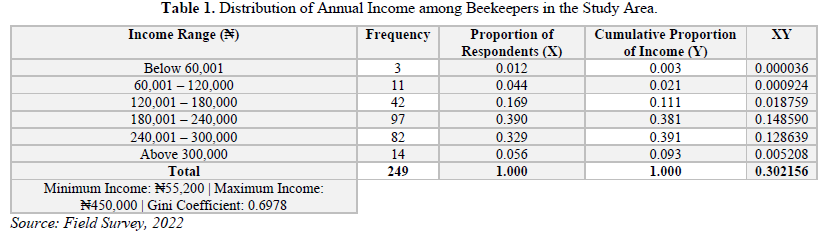
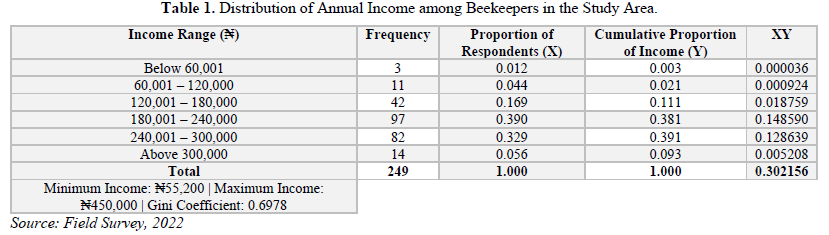
The income distribution analysis (Table 1) yielded a Gini coefficient of approximately 0.70 — a value close to unity, indicating substantial inequality in earnings across the sampled beekeepers. Several factors plausibly account for this dispersion. First, inconsistent or sub-optimal utilization of the available improved hive technologies limited productivity gains for a segment of beekeepers. Second, intrusions by Fulani pastoralists and associated theft events considerably reduced honey yields for affected households. Consistent with Traynor et al. (2016), pesticide residue accumulation in stored bee bread and wax combs can impair queens' reproductive capacity, weaken colonies and precipitate costly and disruptive queen replacement cycles. Third, the absence of a structured and centralized marketing platform for bee products meant that price-setting remained uncoordinated, resulting in wide variation in revenues even among beekeepers with comparable output levels.
Effects of Improved Beehive Technology Adoption on Income and Welfare Status
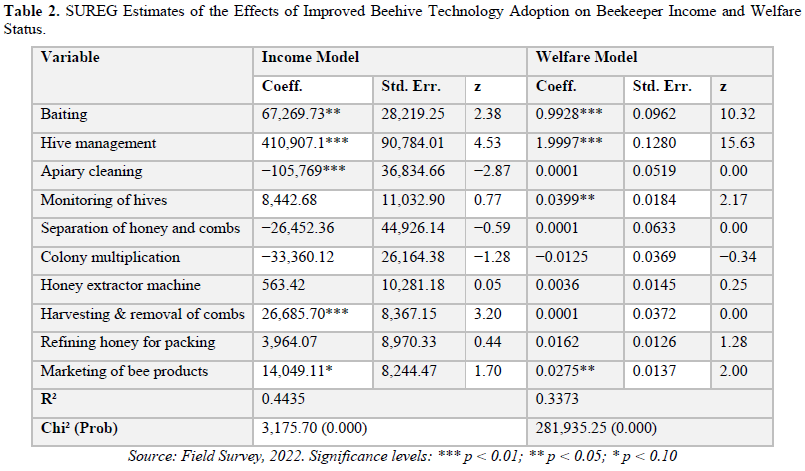
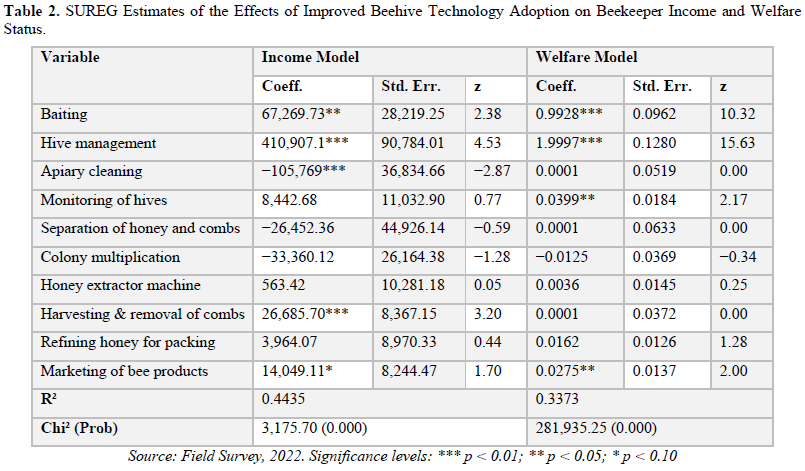
The SUREG results presented in Table 2 simultaneously model beekeeper income and welfare status as dependent variables. The statistical significance of the Breusch-Pagan chi-square statistic (p < 0.01) confirmed non-zero cross-equation error correlations, validating the appropriateness of the SUREG specification over separate ordinary least squares models. Root Mean Square Error values approximating zero for both equations further confirmed strong model fit.
Income Equation
Among the technology-adoption variables, hive management demonstrated the strongest income effect, with a coefficient of 410,907.1 (p < 0.01), underscoring the critical importance of maintaining healthy and productive bee colonies as a foundation for yield improvement. Baiting returned a positive and significant coefficient of 67,269.73 (p < 0.05), consistent with the expectation that effective colony recruitment through baiting raises colonization rates and, consequently, productive output. Honey comb harvesting and removal likewise exerted a positive significant influence (coeff. = 26,685.697; p < 0.01), confirming that timely and proper harvesting practices are directly tied to income realization. Marketing of bee products was positively significant at the 10 percent level (coeff. = 14,049.11), suggesting that operating within price-regulated, organized marketing channels confers measurable income gains on beekeepers.
Conversely, apiary cleaning yielded a negative and statistically significant coefficient (−105,769; p < 0.01). This counterintuitive finding is attributed to the use of inappropriate cleaning methods in the study area, including forcible opening of hive entrances and the application of herbicides for vegetation management around apiaries — practices that disrupt colony stability rather than enhance it.
Welfare Status Equation
Hive management exerted the most substantial positive effect on welfare (coeff. = 1.9997; p < 0.01), affirming that sustained colony health translates into measurable improvements in beekeeper household living standards. Baiting also contributed positively and significantly to welfare (coeff. = 0.9928; p < 0.01). Hive monitoring, though smaller in magnitude (coeff. = 0.0399; p < 0.05), made a statistically significant positive contribution, reflecting the welfare dividend of early identification of colony health challenges. Marketing of bee products registered a positive welfare effect as well (coeff. = 0.0275; p < 0.05), reinforcing the importance of market access and commercial engagement for broader household wellbeing.
Constraints to the Adoption of Improved Beehive Technologies
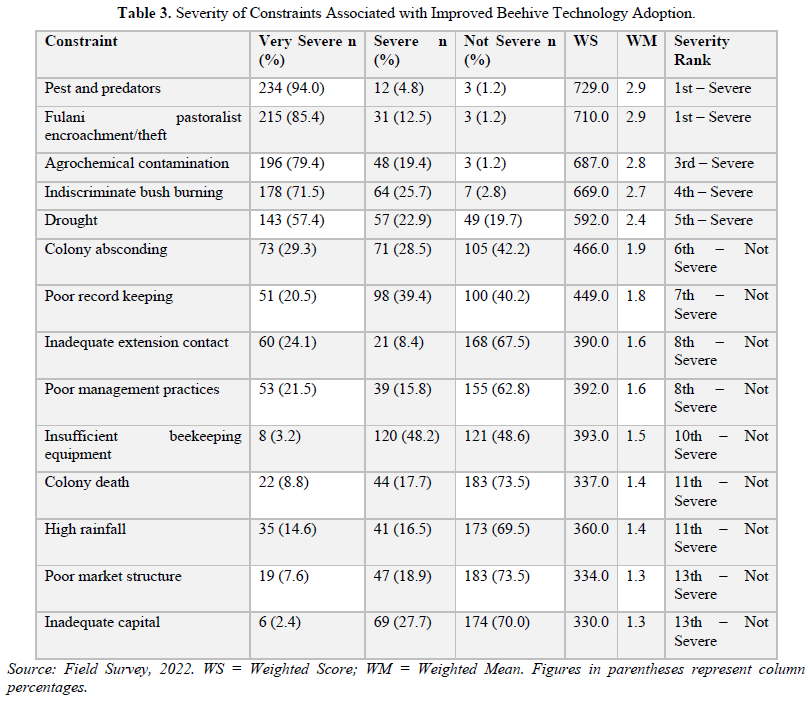
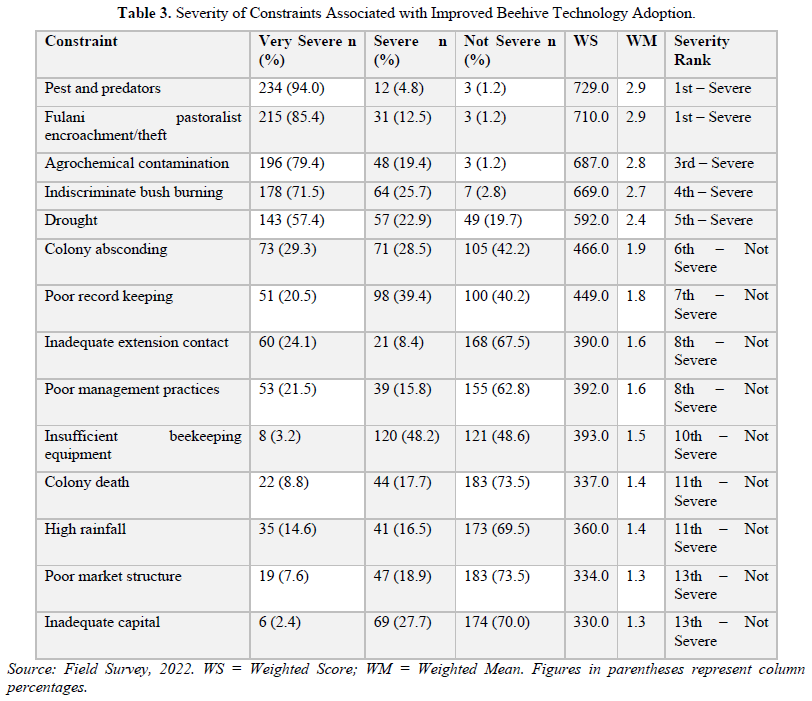
Table 3 presents the weighted mean scores for constraints identified by respondents as barriers to improved beehive technology adoption. Pest and predator pressure and Fulani pastoralist encroachment/theft were jointly ranked first (WM = 2.9 each), both qualifying as severe constraints. Bees are highly sensitive to disturbance; even low-level interference with colony activity can trigger mass absconding, wherein an entire colony abandons the hive. Disease and pest incursions compound this vulnerability by further weakening colonies already stressed by external disturbance.
Agrochemical misuse emerged as the third most severe constraint (WM = 2.8). Widespread and indiscriminate spraying of pesticides and insecticides by neighboring crop farmers poses a lethal hazard to foraging bees, which are unavoidably exposed to chemical residues on visited flowers. The toxicological impact extends beyond individual bee mortality to sublethal effects on queen fertility and colony cohesion, as documented in the literature (Traynor et al., 2016).
Indiscriminate bush burning, particularly prevalent during the dry season when farmers clear land for cultivation, ranked fourth (WM = 2.7). The intense heat generated by uncontrolled fires destroys bee colonies and eliminates the floral resources upon which bees depend for foraging. Drought ranked fifth (WM = 2.4), with its primary impact manifesting through depletion of forage plants and water sources that sustain bee colonies, ultimately prompting colony migration to more resource-abundant environments. Constraints ranked below the threshold of severity (WM < 2.0) included colony absconding, poor record keeping, limited extension contact, inadequate equipment, colony death, high rainfall, poor market structure, and insufficient capital.
CONCLUSION AND RECOMMENDATIONS
This study established that the adoption of improved beehive technologies exerts a measurable positive influence on both the income and welfare outcomes of beekeepers in Ekiti State, with hive management and baiting emerging as the most consequential practices. Notwithstanding these gains, pronounced income inequality (Gini = 0.70) persists among beekeepers, driven largely by uneven technology utilization, security threats from Fulani pastoralist encroachments, and the absence of organized marketing systems. Environmental and ecological stressors — particularly pest pressure, agrochemical drift, bush burning, and drought — compound these challenges.
On the basis of these findings, the study recommends the following: beekeeping associations at the local, state, and national levels, in collaboration with government extension services and non-governmental organizations, should scale up skills-based training on proper hive management, safe apiary cleaning, and structured honey harvesting. Capacity-building efforts should equally target marketing literacy and the formation of cooperative marketing structures to reduce price volatility and improve income equity. Policymakers should pursue inter-sectoral dialogue between the ministries responsible for agriculture, environment, and security to address the persistent threats of pastoralist encroachment, agro-chemical misuse, and bush burning. Future research should examine the long-term welfare trajectories of adopting versus non-adopting beekeepers and explore the potential of digital platforms for extending market access and agronomic advisory services to beekeeping households in Nigeria.

No Files Found


Internationally Accepted
Share Your Publication :