
-
Publish Your Research/Review Articles in our High Quality Journal for just USD $99*+Taxes( *T&C Apply)
Offer Ends On
Publish Your Research/Review Articles in our High Quality Journal for just USD $99*+Taxes( *T&C Apply)
Offer Ends On
Bernard Moeketsi Hlalele*, Mokhantso Makoae and Narnia Bohler-Muller
Corresponding Author: Bernard Moeketsi, Human Sciences Research Council, Developmental, Capable and Ethical States Division Pretoria, 0002, South Arica.
Received: February 11, 2026 ; Revised: February 16, 2026 ; Accepted: February 18, 2026 ; Available Online: February 19, 2026
Citation: Hlalele BM, Makoae M & Bohler-Muller N. (2026) Evaluating Synergies and Disparities in South Africa’s Disaster and Climate Governance Frameworks. J Agric For Meterol Stud, 4(3): 1-10.
Copyrights: ©2026 Hlalele BM, Makoae M & Bohler-Muller N. This is an open-access article distributed under the terms of the Creative Commons Attribution License, which permits unrestricted use, distribution, and reproduction in any medium, provided the original author and source are credited.
Views & Citations
Likes & Shares
As climate-related risks intensify on a global scale, there is an increasing acknowledgment of the necessity for harmonized legal frameworks that integrate disaster risk reduction (DRR), climate change adaptation (CCA), and sustainable development. In South Africa, this imperative is particularly pressing due to the nation’s high exposure to both sudden-onset and slow-onset hazards. The recent enactment of the Climate Change Act 22 of 2024 represents a significant policy advancement, complementing the Disaster Management Act 57 of 2002 and aligning domestic legislation with the international Sendai Framework for Disaster Risk Reduction 2015-2030. This study sought to identify areas of synergy, misalignment, and legal fragmentation among these three instruments, providing insights into how integrated governance could enhance South Africa’s capacity for coordinated disaster response and climate resilience. Employing thematic document analysis, the study critically examined these three documents to systematically identify patterns of convergence and divergence across nine governance dimensions. The analysis revealed substantive synergies in multi-hazard planning, institutional coordination, and stakeholder inclusion, which collectively establish a baseline for cross-sectoral alignment. However, significant disparities remain. The Sendai Framework, while strategic and comprehensive, is a non-binding global instrument, whereas the DMA and CCA operate under domestic legislative authority. Institutional arrangements differ markedly: the DMA mandates the establishment of disaster-specific centers, while the CCA introduces climate-specific governance bodies. Furthermore, the DMA lacks provisions related to climate adaptation, in contrast to the CCA’s detailed obligations. Monitoring and evaluation approaches also diverge, resulting in disjointed metrics and fragmented reporting systems. These findings highlight the necessity for legislative harmonization to address implementation gaps and enhance institutional coherence. The study therefore advocates for policy alignment, integrated planning, and regulatory reform to foster coherence across DRR and climate governance frameworks. It is recommended that South Africa pursues a unifying legal architecture capable of translating global commitments into actionable national policies, thereby strengthening resilience and ensuring more effective disaster and climate governance.
Keywords: Disaster Risk; Climate Change; Legal Fragmentation; Integrated Governance; Sendai Framework for Disaster Risk Reduction
INTRODUCTION
As climate-related risks intensify globally, countries are increasingly recognizing the need for cohesive governance frameworks that bridge disaster risk reduction (DRR), climate change adaptation (CCA), and sustainable development. South Africa, a country vulnerable to both sudden-onset and slow-onset hazards, has recently strengthened its legal frameworks through enacting of the Climate Change Act of 2024. This complements the long-standing Disaster Management Act (DMA) of 2002 and aligns the country’s domestic commitments with international norms such as the Sendai Framework for Disaster Risk Reduction 2015-2030 (Aitsi-Selmi & Murray, 2015), and lays the foundation for developing policies and strategies for all-encompassing vulnerability reduction initiatives that emphasize health, development and climate change for various agencies to implement (Etongo et al, 2025; Nekoei-Moghadam, Moradi & Tavan, 2024). The Sendai Framework emphasizes integrated approaches across sectors and levels of governance to build resilience and reduce vulnerability, a principle that is particularly relevant for countries like South Africa facing multifaceted climate and disaster risks (Cubie & Natoli, 2021). The Sendai Framework promotes four priorities for action, including strengthening disaster risk governance and enhancing resilience through coherent legal and institutional systems.
However, integrating these principles across national legislative domains remains a challenge. Research suggests that while many countries have adopted overlapping climate and disaster governance instruments, the lack of alignment, horizontal integration and coordination often leads to institutional fragmentation and policy inefficiencies (Cubie & Natoli, 2021). This issue is particularly pronounced in Africa, where governance structures, insufficient democratization of public participation and limited data capacity hinder the realization of Sendai’s goals (van Niekerk et al., 2020).
In the South African context, recent studies emphasize the urgency of harmonizing DRR and climate adaptation policies. Walz et al. (2020) highlighted the practical limitations in implementing Sendai indicators at the national level due to data constraints, illustrating a need for more integrated policy systems and monitoring tools. Similarly, the current South African frameworks lack coordination across levels of governance, with national policies often failing to reflect local realities and priorities (Sowman & Rebelo, 2021). This study intends to examine the legislative interplay between South Africa’s DMA, the 2024 Climate Change Act, and the Sendai Framework. It aims to identify areas of synergy, misalignment, and legal fragmentation, providing key insight into how integrated governance could enhance South Africa’s capacity for coordinated disaster response and climate resilience.
The evolution of disaster and climate governance in South Africa
South Africa’s governance approach to disaster risk reduction (DRR) and climate change adaptation (CCA) has undergone significant evolution over the past two decades, reflecting both localized vulnerabilities and global policy shifts. Although South Africa was among the early adopters of proactive disaster legislation in Africa, the integration of climate policy frameworks has lagged. The formal journey into disaster risk governance commenced with the Disaster Management Act (DMA) of 2002, which marked a substantial shift from reactive emergency responses to a more proactive and preventive paradigm. This act institutionalized disaster risk management at national, provincial, and municipal levels, emphasizing preparedness, early warning systems, and risk reduction rather than merely crisis response (Culwick, 2018). However, climate change had not yet been fully integrated into national policy at the time of the DMA’s enactment. It was only with increasing international and domestic pressure, particularly following South Africa’s commitments under the United Nations Framework Convention on Climate Change (UNFCCC), that climate governance began to emerge as a formal policy concern. Recent years have witnessed notable progress, particularly with the Climate Change Act of 2024, which directly incorporates adaptation and mitigation mandates across government sectors.
Despite these significant legislative advancements, a persistent challenge has been the parallel development of DRR and CCA governance structures. Becker et al. (2021) identified the duplication of responsibilities and inefficiencies arising from these silos. Their study of Southern African countries, including South Africa, found that DRR and CCA are often implemented by separate institutions, resulting in competition for resources, uncoordinated efforts, and policy fragmentation (Becker, Hagelsteen & Abrahamsson, 2021). This fragmentation is further exacerbated by differing mandates: while DRR structures are grounded in civil protection and emergency response, climate governance is frequently situated within environmental departments. This administrative bifurcation undermines efforts to implement coherent strategies that address the full spectrum of risks posed by both slow-onset climate phenomena and sudden disasters.
A critical aspect of the evolution of climate governance in South Africa is the development of climate knowledge systems. Babette Never (2012) examined how knowledge production, communities of practice, and learning loops shape domestic climate governance. Her findings indicate that South Africa has begun to establish a cohesive system of climate governance knowledge; however, these communities of practice often lack the political authority necessary to institutionalize change. Such limitations were also highlighted in more recent research by Matikinca et al. (2024), which revealed that many local municipalities still lack formal climate strategies and fail to integrate DRR and CCA into development planning. Their review of municipal plans in the Eastern Cape uncovered widespread noncompliance with legislative requirements and a tendency to prioritize hard infrastructure over social vulnerability or resilience-building initiatives.
Case-based lessons and regional challenges
The interplay between policy and practice has been significantly influenced by actual disaster experiences. The floods in KwaZulu-Natal and the Eastern Cape in April 2022 revealed numerous deficiencies in preparedness and governance. A study conducted by Ngcamu (2022) highlighted how inadequate urban planning, insufficient early warning systems, and the marginalization of indigenous knowledge systems exacerbated the disaster's impact. This highlights a broader concern: the disparity between improvements in governance on paper and their translation into effective local action. Regional assessments further indicate a structural issue. Nemakonde et al. (2020) articulated the detrimental effects of the fragmentation of institutional mandates for disaster risk reduction (DRR) and climate change adaptation (CCA) across Southern Africa. Their research, which included interviews with South African and regional stakeholders, identified five key adverse consequences: policy incoherence, service duplication, competition for resources, intervention polarization, and bureaucratic conflicts. Although policies are in place, their implementation is compromised by institutional overlap, capacity deficits, and a lack of coherent metrics for evaluating success. Storie (2018) further noted that technical challenges, such as incompatible spatial data formats and weak data governance, hinder the effective mapping and management of disaster and climate risks across jurisdictions. To progress, South Africa must address its governance deficiencies through legal reform and enhanced inter-agency coordination. Aligning the Disaster Management Act (DMA) and Climate Change Adaptation (CCA) efforts under a cohesive resilience policy, informed by both global frameworks like the Sendai Framework and local realities, would facilitate more effective responses to risk.
Institutional coordination and community engagement
Institutional coordination and community engagement are fundamental to enhancing climate and disaster resilience. Within the South African context, achieving coherence among governmental institutions and ensuring the active involvement of local communities in planning processes represent critical yet underdeveloped dimensions of disaster risk reduction (DRR) and climate change adaptation (CCA). Despite the existence of formal policies, institutional coordination across various levels of government and departments remains inconsistent and frequently fragmented. Mthembu and Nhamo (2022) conducted a critical evaluation of South Africa’s adaptation frameworks in alignment with Sustainable Development Goal 13 (climate action) and identified that, although numerous adaptation policies are in place, they are disjointed across different departments and sectors. This fragmentation has led to policy overlap, ineffective local implementation, and a lack of a unified vision or leadership for adaptation initiatives (Mthembu & Nhamo, 2022). Additionally, Makaya et al. (2020) investigated institutional coordination in water governance concerning drought management in rural Limpopo. Their research revealed that ambiguous roles, communication barriers, and top-down approaches significantly hindered local efforts to enhance drought resilience. They emphasized the necessity of clarifying mandates and promoting collaboration among water and disaster risk institutions to address these systemic deficiencies.
Community engagement: Tokenism vs. Participation
The engagement of communities in Disaster Risk Reduction (DRR) and Climate Change Adaptation (CCA) remains a legal obligation in South Africa; however, substantive participation is frequently inadequate. Sowman and Rebelo (2021), in their investigation of coastal fishing communities, observed that national policies were inadequately aligned with local requirements. Despite the occurrence of regular consultations, local perspectives were seldom incorporated into the final policy frameworks. They advocate for an enhanced acknowledgment of local knowledge systems and the establishment of improved feedback mechanisms between communities and planners. Correspondingly, Busayo and Kalumba (2020) identified that, in East London, community understanding of DRR and CCA was limited. Although disaster-related information was accessible in local languages, it was not widely disseminated, and there were insufficient opportunities for communities to influence planning processes. The authors showed the necessity for governments to prioritize two-way communication and participatory planning processes.
Building capacity at local levels
One of the most frequently cited challenges to effective coordination and community engagement is the insufficient capacity, particularly within local government. Becker and Niekerk (2014) contend that although policies may be progressive, the capacity for implementation is undermined by shortages in human resources, inadequate technical training, and institutional inertia. They advocate for the utilization of academic and civil society institutions to address this capacity deficit by promoting long-term skills development within government agencies. Munsamy (2019) emphasizes that political will is equally important.in this context. His research recommends the establishment of national forums and local climate councils that incorporate both government and community representatives to facilitate data-informed and locally driven decision-making in the integration of disaster risk reduction (DRR) and climate change adaptation (CCA).
Bridging the policy-practice gap
Numerous studies point to the persistent gap between policy formulation and implementation. Mugari and Nethengwe (2022) evaluated ecosystem-based disaster risk reduction (DRR) planning in Limpopo and discovered that, despite the formal mandate for community participation, the process lacked depth and failed to yield tangible project outcomes. They advocate for a more robust integration of community perspectives within district and provincial planning processes, emphasizing the necessity for participation to meaningfully influence budget allocations and project selection. In a similar vein, Chauke and Fortuin (2014) documented a project in the Namakwa District wherein local and national authorities collaborated with non-governmental organizations (NGOs) to conduct participatory vulnerability assessments and workshops. They observed that the project's success was attributable to sustained engagement, capacity building, and the incorporation of localized knowledge in policy development, rather than mere consultation for its own sake.
METHODS AND MATERIALS
Theoretical framework
This study is grounded in Governance Theory, which provides a conceptual framework for analyzing the distribution and exercise of authority, control, and coordination among various actors and institutions, particularly within policy environments. Governance Theory transcends traditional top-down governmental control, emphasizing instead horizontal, multi-actor, and multi-level interactions among state, private, and civil society participants (Rhodes, 1996; Kooiman, 2003). The discourse surrounding governance is increasingly relevant in the context of global environmental challenges, wherein adaptive, networked, and participatory governance structures are recognized as essential to addressing uncertainty, and scale (Pierre & Peters, 2000; Jordan, Wurzel, & Zito, 2005). Specifically, scholarship on climate governance and risk governance highlights the necessity for institutional coordination, policy coherence, and the integration of fragmented regulatory frameworks to enhance societal resilience (Lebel et al., 2006; Biermann et al., 2009). These dimensions are particularly critical in contexts such as South Africa, where overlapping legal and policy mandates across disaster management and climate adaptation institutions frequently result in siloed responses.
Within the scope of this study, Governance Theory was employed as an analytical instrument to evaluate the coherence and coordination among three selected documents: the Disaster Management Act (No. 57 of 2002), the National Climate Change Response Policy (2011), and the National Development Plan (2030). Drawing upon the theory’s emphasis on multi-level and multi-actor policy dynamics, the analysis investigated whether these instruments exhibited vertical and horizontal integration, namely, alignment across various levels of government and policy domains (Adger et al., 2005). Furthermore, it assessed the degree to which the frameworks promote inclusive decision-making, institutional accountability, and adaptive capacity, which are central to governance-oriented interpretations of resilience building (Huitema et al., 2009). Through thematic document analysis informed by governance theory, the study identified significant governance gaps, including institutional fragmentation, ambiguous mandates, and limited cross-sectoral coordination mechanisms. Conversely, it also highlighted emerging synergies and potential points of integration, such as the incorporation of climate risk into the NDP’s socio-economic planning agenda. Governance theory provided a facilitate robust foundation for interpreting these findings, particularly in elucidating how institutional arrangements can either or impede effective integration of Disaster Risk Reduction and Climate Change Adaptation (DRR-CCA).
Research paradigm and design
The interpretivist paradigm was deployed to guide this research due to its emphasis on understanding social phenomena within their contextual settings. Interpretivism is grounded in the belief that reality is socially constructed and cannot be comprehensively understood through positivist, objective measures alone (Creswell & Poth, 2018). Given that this study investigates how different legal and policy frameworks interact, converge, or diverge in practice, interpretivism facilitates a critical analysis of legislative texts and the underlying governance philosophies they embody. As Neuman (2014) elucidates, interpretivist research seeks to “understand how people construct and sustain their social worlds,” rendering it particularly suitable for policy and legal research where meaning is derived from institutional documents, intentions, and language use. This paradigm supports a deep analysis of policy instruments that are not merely technical documents but also reflections of political, social, and environmental ideologies.
A qualitative approach was adopted as the primary methodological orientation. Qualitative research is especially valuable when the objective is to explore social, legal, and institutional relationships rather than to measure variables numerically. Denzin and Lincoln (2018) assert that qualitative methods enable researchers to explore the “why” and “how” of policy phenomena, which is critical for unpacking the multidimensional interactions between disaster and climate governance frameworks. Qualitative inquiry facilitated a comprehensive examination of the intentions, gaps, and overlaps within the Disaster Management Act (DMA), Climate Change Act (CCA), and Sendai Framework by interpreting not only content but also the structural and normative underpinnings of these instruments. This approach permitted the study to transcend surface-level descriptions to achieve thematic synthesis and critical interpretation (Bowen, 2009). To systematically explore the similarities and differences across the selected frameworks, the study employed a comparative case-based design. Yin (2014) notes that comparative case study research is ideal for exploring contemporary phenomena within real-life contexts, particularly when the boundaries between phenomenon and context are blurred, as is the case in governance and policy systems. The three cases the DMA (2002), the CCA (2024), and the Sendai Framework (2015) were purposefully selected due to their significant influence on South Africa’s disaster and climate governance landscape. By analyzing them in tandem, the study was able to identify points of synergy, misalignment, and legal fragmentation that might not be discernible through single-case analysis. Stake (2006) argues that case study research is valuable not only for understanding the unique qualities of each case but also for revealing cross-case patterns and deeper institutional logics. This was essential for revealing how South African legislation interacts with global policy instruments and identifying opportunities for policy harmonization.
Data collection methods
This study utilized document analysis as the principal method of data collection, as it is particularly effective for investigating the governance dynamics inherent in legal and policy texts. Document analysis allows researchers to extract meaning, enhance understanding, and develop empirical knowledge from written materials that are frequently accepted as normative within policy contexts (Bowen, 2009). In this research, a thorough review was conducted of national legal texts, policy frameworks, and strategic plans directly pertinent to disaster risk reduction (DRR) and climate change adaptation (CCA) in South Africa. These documents were systematically analyzed to reveal patterns of governance alignment, identify legislative and institutional deficiencies, and evaluate the extent of structural cohesion across policy domains. This methodology aligns well with the increasing academic focus on integrated climate governance and policy coherence (Ziervogel et al., 2014; Roberts et al., 2020).
Population and sampling techniques
The document population comprised three legal instruments that are publicly accessible and officially recognized by the South African government, relevant to Disaster Risk Reduction (DRR) and Climate Change Adaptation (CCA). Given the qualitative and exploratory nature of this study, purposive sampling was employed to identify documents of significant strategic and legal relevance. The three primary documents selected include the Disaster Management Act (No. 57 of 2002, as amended), the National Climate Change Response Policy (2011), and the National Development Plan (NDP) 2030. These instruments were selected for their prominence in shaping national discourse on resilience and their direct alignment with international mandates, such as the Sendai Framework for Disaster Risk Reduction (2015-2030) and the Paris Agreement. In this context, purposive sampling aligns with Bryman’s (2016) recommendation to target documents that provide the most insight into the research problem, particularly when the objective prioritizes depth over breadth. To analyze these documents, the study utilized thematic content analysis as articulated by Braun and Clarke (2006), an approach particularly well-suited for policy analysis, where both latent and manifest meanings within the text are of interest. The analysis commenced with familiarization, wherein the documents were read repeatedly to immerse the researcher in the content. Subsequently, a structured coding protocol was developed based on key research questions and thematic expectations derived from a preliminary literature review. Codes were applied line-by-line, ensuring a consistent and traceable process. Initial codes were then organized into broader thematic categories, including institutional alignment, legal coherence, policy integration, implementation barriers, and the mainstreaming of climate risks.
Themes emerged inductively; rather than fitting data into predefined categories, the analysis permitted patterns to surface organically from the text. To ensure the reliability of the findings, a clear and replicable coding scheme was developed and applied consistently across all documents. Inter-coder reliability was assessed by having a second researcher independently code a sample of the data, with agreement exceeding 85%. Validity was further enhanced through triangulation, which included cross-document comparison, peer debriefing within the research team, and comparison with scholarly literature on DRR-CCA integration, both within South Africa and internationally (Leck & Simon, 2018; Ziervogel et al., 2014). This triangulated approach mitigated potential biases inherent in qualitative analysis and helped ensure that the themes identified in the primary documents corresponded with broader patterns observed in academic discourse and international practice. The decision to employ document analysis as a core method is further supported by contemporary scholarship emphasizing the role of texts in shaping policy outcomes and institutional behavior (O’Leary, 2017). Moreover, by concentrating on foundational national documents, this study captures the formal architecture of DRR-CCA governance, thereby providing a lens through which the dynamics of actual implementation and coherence challenges can be understood. As noted by Roberts et al. (2020), national-level instruments establish the framework for subnational implementation, particularly within decentralized governance systems such as that of South Africa.
RESULTS
Institutional architecture: Coordination vs. Fragmentation
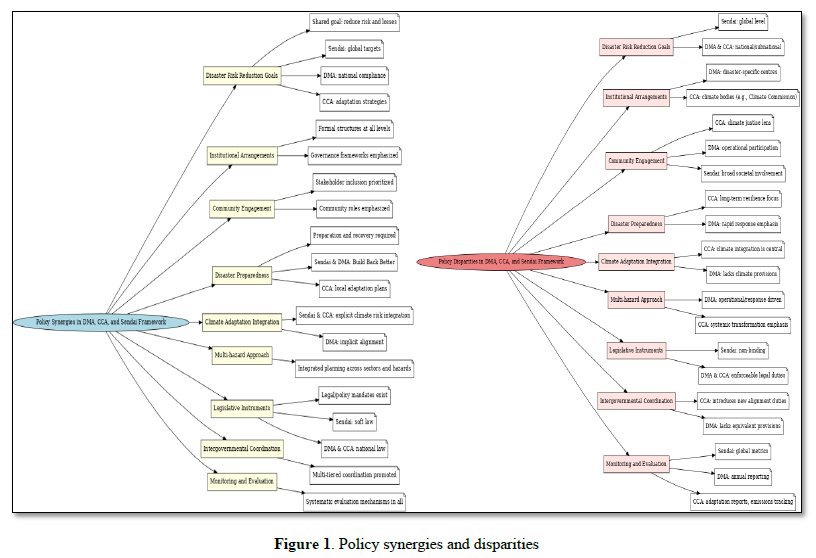
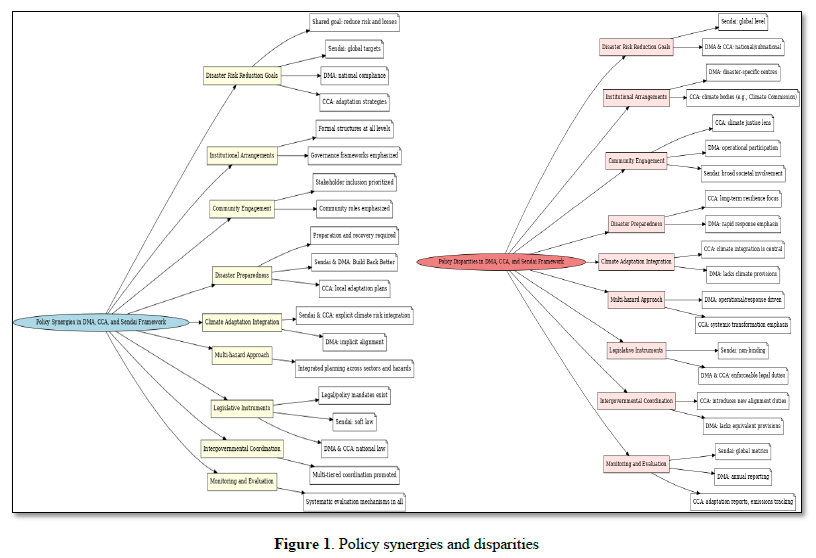
Institutional arrangements across the three governance frameworks namely the Disaster Management Act (DMA), the Climate Change Act (CCA), and the Sendai Framework exhibit significant synergies in their emphasis on multi-level governance and structural coordination. Each framework recognizes the necessity of institutional platforms to facilitate planning and implementation. The DMA establishes disaster management centers at national, provincial, and municipal levels, while the CCA introduces climate-specific bodies such as the Presidential Climate Commission and municipal climate forums. These institutions reflect a shared understanding that effective disaster risk reduction (DRR) and climate change adaptation (CCA) necessitate coordinated institutional mechanisms. Similarly, the Sendai Framework, although not prescriptive, advocates for national coordination mechanisms as part of its priority actions. Nonetheless, substantial disparities arise in the fragmentation of institutional roles and mandates. The frameworks often operate in isolation, with limited cross-referencing or integrative structures to promote inter-institutional collaboration. The disaster-specific institutions established by the DMA and the climate governance entities mandated by the CCA frequently function with parallel responsibilities, resulting in duplication of efforts and inefficient resource utilization. Furthermore, the non-binding nature of the Sendai Framework diminishes its enforceability, hindering the establishment of institutional coherence at the national level and exacerbating governance fragmentation. This misalignment undermines cohesive responses to overlapping disaster and climate risks, a concern echoed in the findings of Becker et al. (2021), which highlight similar institutional bifurcation across Southern Africa.
Legal and policy coherence: Converging intent, diverging mandates
Legal and policy coherence across the frameworks demonstrates alignment in principle but divergence in application. All three frameworks articulate shared objectives concerning risk reduction, resilience-building, and the integration of risk considerations into development planning. This alignment establishes a conceptual foundation for integrated governance and reflects a growing international consensus on the necessity to unify Disaster Risk Reduction (DRR) and Climate Change Adaptation (CCA) efforts. However, their mandates differ markedly in focus and scope. The CCA, as a contemporary legal instrument, encompasses explicit obligations related to climate adaptation and mitigation, along with established reporting mechanisms and institutional responsibilities. In contrast, the Disaster Management Act (DMA), enacted in 2002, predates the mainstream climate discourse in South African policy and therefore lacks formal provisions addressing climate change adaptation. This legal gap necessitates interpretive alignment rather than explicit integration. The Sendai Framework, while providing strategic direction, remains legally non-binding and relies on domestic legislation for its implementation. Consequently, this results in a lack of legal continuity across the instruments, contributing to operational disjunctions and limiting the capacity for cohesive implementation. The findings highlight the urgent need for legislative harmonization, including the potential amendment of the DMA to incorporate climate risks and adaptation strategies.
Community engagement and participation: Normative commitment vs. practical exclusion
A consistent normative synergy exists across the three frameworks regarding the centrality of community engagement. The Disaster Management Act (DMA), the Climate Change Adaptation (CCA), and the Sendai Framework all recognize that local communities are essential actors in building resilience and reducing vulnerability. The CCA, in particular, embeds principles of climate justice and frames community participation as fundamental to achieving a just transition. Similarly, the Sendai Framework advocates for inclusive, people-centered approaches to disaster risk governance, while the DMA mandates stakeholder involvement through advisory forums and participatory structures. However, this rhetorical commitment often fails to translate into substantive participatory mechanisms. In practice, community engagement is frequently tokenistic, characterized by one-directional consultation that lacks meaningful incorporation of local perspectives into final decisions. As highlighted by Sowman and Rebelo (2021), many local planning processes in South Africa do not adequately reflect lived experiences, particularly those of marginalized groups. This disconnect diminishes the potential for community-based resilience and reinforces top-down governance patterns. Busayo and Kalumba (2020) further illustrate that even when information is available in local languages, opportunities for local input into disaster risk reduction and climate change adaptation planning remain minimal. Therefore, despite shared principles of engagement, implementation practices continue to exclude community agency and local knowledge systems from governance processes.
Disaster preparedness and climate adaptation: Strategic Intent vs. operational misalignment
Another thematic convergence is identified in the prioritization of proactive risk reduction over reactive responses. The Climate Change Adaptation (CCA) framework promotes long-term resilience through anticipatory planning and systemic transformation, while the Sendai Framework emphasizes both prevention and preparedness as foundational elements of disaster governance. Although the Disaster Management Act (DMA) has traditionally been associated with emergency response, it also incorporates components of risk reduction and early warning. Despite this strategic alignment, the operational focus of the DMA remains predominantly oriented toward short-term response and recovery. It lacks the adaptive planning tools necessary to address slow-onset climate phenomena, which are central to the CCA. Consequently, adaptation efforts are institutionally disconnected from disaster preparedness mechanisms. This disjunction impedes the development of integrated strategies capable of addressing compound and cascading risks. Local municipalities, as noted by Matikinca et al. (2024), frequently exhibit this inconsistency in their plans, which tend to prioritize hard infrastructure over adaptive social strategies. Therefore, the failure to incorporate climate adaptation within disaster legislation constitutes a significant gap in South Africa’s resilience governance framework.
Monitoring, evaluation, and data coherence: common purpose, divergent systems
All three frameworks demonstrate a shared commitment to monitoring and evaluation (M&E) as critical mechanisms for ensuring accountability and enhancing policy development. The Sendai Framework delineates global targets and indicators aimed at assessing progress in disaster risk reduction (DRR). The Climate Change Adaptation (CCA) framework encompasses comprehensive provisions for monitoring greenhouse gas emissions, adaptation initiatives, and the synthesis of climate-related data. Additionally, the Disaster Management Act (DMA) necessitates the submission of annual disaster management reports by both national and local authorities. This alignment, the frameworks employ divergent metrics, methodologies, and timeframes, resulting in a fragmented landscape for data collection and reporting. This fragmentation hinders comparative analyses and diminishes the potential for integrated evaluations. Furthermore, technical challenges, such as incompatible spatial formats and inadequately developed data governance structures (Storie, 2018), further impede efforts to harmonize M&E across various sectors. The lack of a standardized national indicator framework that aligns with both climate and disaster risk objectives restricts evidence-based decision-making and undermines international reporting obligations. Addressing these disparities necessitates not only technological integration but also institutional reforms aimed at fostering interoperability and establishing shared accountability systems.
Multi-hazard risk planning: Shared vision, structural divide
All three frameworks advocate for the principle of multi-hazard planning and integrated risk assessments. The Disaster Management Act (DMA) supports a multi-hazard approach to the management of sudden-onset disasters. In contrast, the Climate Change Adaptation (CCA) framework addresses slow-onset, systemic climate risks, while the Sendai Framework emphasizes comprehensive risk governance that encompasses natural, biological, and anthropogenic hazards. Nonetheless, these frameworks operationalise the multi-hazard principle in divergent ways, resulting in minimal convergence in practice. The DMA’s multi-hazard planning is predominantly event-focused and often reactive, whereas the CCA’s methodology is characterized by a long-term, transformative perspective. Although the Sendai Framework provides guidance, it lacks an enforceable implementation model. These structural disparities contribute to gaps in risk integration and restrict the capacity for coherent, systems-based planning. In the absence of a unified strategy that reconciles short-term shocks with long-term stressors, South Africa faces the risk of misallocating resources and inadequately responding to the full spectrum of risks.
CONCLUSION AND RECOMMENDATIONS
This study aimed to investigate the extent to which South Africa’s principal governance instruments the Disaster Management Act (DMA), the Climate Change Act (CCA), and the Sendai Framework for Disaster Risk Reduction converge or diverge in their efforts to enhance resilience through integrated disaster risk reduction (DRR) and climate change adaptation (CCA). Utilizing a governance-theory framework and thematic document analysis, the study identifies significant synergies in normative objectives, including resilience-building, institutional coordination, and the acknowledgment of community participation. However, these synergies are compromised by persistent disparities in legal authority, operational scope, institutional mandates, and monitoring systems. Both the DMA and CCA, while legally binding, operate largely in parallel with limited cross-sectoral integration. The DMA predominantly focuses on reactive disaster response with minimal provisions for adaptation, whereas the CCA prioritizes long-term resilience and systemic climate transformation. Although strategically aligned with both acts, the Sendai Framework lacks enforceable mechanisms for integration at the national level. Furthermore, community engagement is predominantly rhetorical, with inadequate mechanisms for meaningful local influence. Fragmented monitoring and evaluation frameworks further complicate implementation, hindering efforts to assess progress.
In light of these findings, it is clear that without legislative alignment, institutional collaboration, and coherent implementation mechanisms, South Africa risks perpetuating policy silos that diminish its resilience to both climate-related and other hazards. Addressing these gaps is not merely a technical necessity but a critical governance imperative, particularly in a context increasingly characterized by compound risks and systemic vulnerabilities. To tackle these challenges, the study recommends a legal harmonization process that aligns the DMA with contemporary climate imperatives, particularly by incorporating explicit adaptation and resilience mandates. A unified legislative framework would promote coherence, reduce redundancy, and ensure that both slow-onset and rapid-onset hazards are addressed within a single, integrated governance structure. Moreover, institutional arrangements must be restructured to foster collaboration rather than competition, including the establishment of inter-ministerial coordination bodies and shared implementation platforms at both national and municipal levels. Efforts to enhance community engagement must transcend mere consultation towards participatory governance, wherein local knowledge is formally integrated into planning and resource allocation processes. This necessitates the development of policy tools that facilitate co-decision-making and sustained community partnerships. Furthermore, South Africa should adopt a national framework for integrated monitoring and evaluation that harmonizes the metrics employed in DRR and CCA, in alignment with both domestic priorities and international reporting obligations. Such an initiative would require technical investment in interoperable data systems and capacity-building at the local level to ensure consistency and accountability. Future research should expand the analytical framework to include the National Environmental Management Act (NEMA), given its substantial procedural and normative alignment with the Climate Change Act (CCA) and its synergistic role in facilitating Disaster Risk Reduction (DRR) under the Disaster Management Act (DMA). Although NEMA was not originally designed as a climate or disaster-specific instrument, its provisions related to sustainable development, environmental impact assessments, and ecosystem-based management present significant opportunities for integrated resilience planning. Integrating NEMA into future studies would provide a more comprehensive understanding of South Africa’s legal framework, highlighting opportunities to harmonize environmental, climate, and disaster governance. Such research could also identify mechanisms for enhancing cross-sectoral coordination, reducing legal fragmentation, and promoting cohesive implementation frameworks that support both long-term adaptation and immediate risk management.

No Files Found


Internationally Accepted
Share Your Publication :