
-
Publish Your Research/Review Articles in our High Quality Journal for just USD $99*+Taxes( *T&C Apply)
Offer Ends On
Publish Your Research/Review Articles in our High Quality Journal for just USD $99*+Taxes( *T&C Apply)
Offer Ends On
N. Chinglen Meitei* and Jayanta Dutta
Corresponding Author: N. Chinglen Meitei, Project Assistant, ICAR Research Complex for NEH Region, Manipur Centre, India.
Received: September 11, 2026 ; Revised: September 18, 2026 ; Accepted: September 21, 2026 ; Available Online: September 23, 2026
Citation:
Copyrights:
Views & Citations
Likes & Shares
Farm credit plays a game changer’s role in redirecting the agricultural activities according to the needs and priorities of deprived farmers. It is a felt need of the hourto understand the sources of credit, level of access inequality and factors determining the access to credit. To meet the objectives 100 beneficiary farmers (borrowers) and 100 non-beneficiaries (non-borrowers) from 10 villages under two blocks of Dakshin Diaper district were collected. Thiele’s index and binomial logit regression was used for analysing the primary data. The Theil’s index of inequality was 0.69 for beneficiary farmers and 0.71 for non-beneficiary farmers. The difference indicates that level of access to credit varies among beneficiary and non-beneficiary farmers cultivating rice. Age of respondent, size of landholdings, membership, credit awareness was significant and positively related while interest rate was found negatively significant to dependent variable. Constant endeavors are needed to see that rural and agricultural facilities are enhanced with the passage of time.
Keywords: Beneficiary, Logit regression, Theil’s index, Odds Ratio, Inequality
JEL Codes: Q14, C81, C87, G21
INTRODUCTION
Capital-intensive nature of modern agricultural technology and inadequate savings of the farmers have encouraged the common farmers to go for external finances from different sources, both institutional and non-institutional sources. Farm credit plays the role of an accelerator in the agricultural development provided it is adequate in quantity, cheap and development oriented. Indian agriculture has always remained dominated by small and marginal holders who are often constrained by capital of their own or lack of access to institutional credit in their endeavor to transit from subsistence to commercial production systems. Generally, farmers demand for two types of credit, one is considered as short-term credit to meet the current expenditure on seeds, fertilizer, insecticides, pesticides, hired laborer, transportation of harvested product to the farm houses, etc. and the other is long term credit to meet the capital expenditure on bullocks, power tiller, farm house, modern machinery, rent for leased in land, etc. Non-availability of timely credit has been a major drawback for the agricultural sector in India. Without sufficient credit support, growth of agriculture cannot be accelerated particularly looking into the status of capital-starved farmers at large. Therefore, farm credit plays a game changer’s role in redirecting the agricultural activities according to the needs and priorities of deprived farmers.
Failure of timely availability of farm credit during peak season derails the farming activities. The fact remains that the majority of the marginal and small farmers cannot afford to acquire modern inputs and agricultural implements from their own source due to lack of market intervention of their output which are essential for adoption of improved technology in agriculture. Sometimes, poor marginalised farmers have to borrow from the village money lenders at exorbitantly high rate of interest which badly affect the farmers. Hence forth, it is a felt need of the hour to understand the sources of agricultural credit market, degree of inequality in credit access and factors which determine access to farm credit in the study area.
METHODOLOGY
To meet the objectives of the study, primary data were collected from 200 potato growers in the selected villages using pre-tested structured schedule through personal interview of the respondents for the calendar year 2022-23. Among the farmers included in the study, data were collected from 200 respondents, comprising 100 beneficiary farmers who had borrowed agricultural credit from institutional sources (institutional borrowers) and 100 non-beneficiary farmers who had not availed themselves of institutional credit (non-institutional borrowers). The respondents were selected from 10 villages across two blocks of the Dakshin Dinajpur district using the Simple Random Sampling Without Replacement (SRSWOR) technique. Both beneficiary and non-beneficiary farmers were further grouped into marginal (2 ha) farmers based on their respective sizes of land holdings. The data collected from the respondents comprise of sources of farm credit, level of access to farm credit and its determinants. Access to credit can be measured in terms of proportion of operational holdings which could avail credit and also in terms of amount they could obtain. Theil’s index can be computed to measure the inequality among ‘m’ groups using the formula. (Conceicao et al., 2000, Priyanka, 2014)
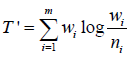
Where,
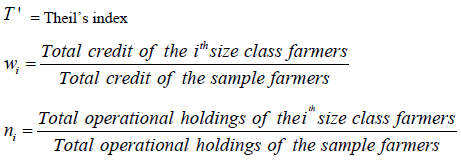
The index value ranges from zero to one
The binomial logit regression model was used to determine the factors influencing farmer’s decision regarding access to agricultural credit in the study area. The logit model was chosen since it is a standard method of analysis when the outcome variable is dichotomous (Hosmer and Lameshow, 2000). Therefore, the cumulative logistic probability model is econometrically specified as follows:

Where,
Pi = the probability that a respondent is borrower (beneficiary) or non-borrower (non-beneficiary) given Xi.
e = the base of natural logarithm, which is approximately equals to 2.71828.
α = constant term
βi = are parameters to be estimated
Xi = the explanatory or predictor variables
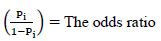
The logistic regression model could be written in terms of odds ratio (OR) and log of odds because it enables one to understand the meaning and the interpretation of the coefficients (Hosmer and Lameshow, 2000). The odds ratio implies the ratio of the probability (Pi) that an individual would choose an alternative to the probability (1- Pi) that the researcher would not choose it.

Therefore, the odds ratio becomes
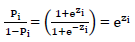
Or to get linearity, we take the natural logarithms of odds ratio in the above equation, which results in the logit
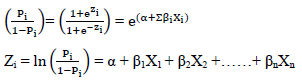
As P goes from 0 to 1 (that is, as Z varies from -∞ to +∞), the logit L goes from -∞ to +∞. That is, although the probabilities lie between 0 and 1, the logit is not so bounded (Gujarati, 2003). If the disturbance term (µ) is taken into consideration and for estimation purpose, the logit model becomes,

Whereby,
i = 1, 2, 3, 4……..8
L = the logit, and hence the name logit model
ln= log
α = the constant term
βi= parameters to be estimated
Xi (i=1…..8) = the explanatory or predictor variables
µ = stochastic error term
Accordingly, the binomial logit regression is used for the present study to determine the factors affecting farmers’ access to credit. The model is based on the following specification
L = α+ β1X1 + β2X2 + β3X3 + β4X4 + β5X5 + β6X6 + β7X7 + β8 X8 + µ
Where,
L= the logit as mentioned above
α = constant term or intercept of the equation.
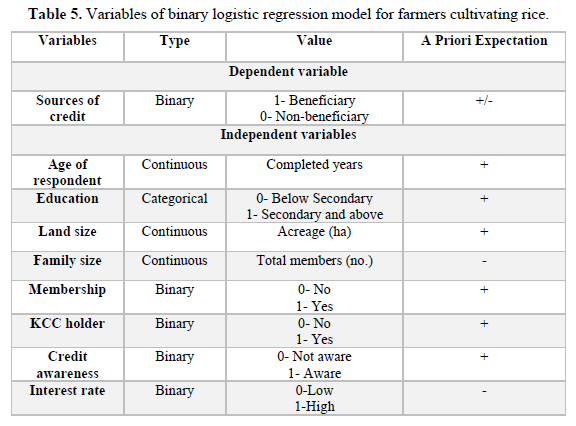
X1= age of respondents (Completed years)
X2= level of education (0- Below Secondary, 1- secondary and above)
X3=sizes of landholdings (Acreage in ha)
X4= family size (Total members)
X5= institutional membership (0- No, 1- yes)
X6= Kisan credit card (KCC) holder (0- No, 1- yes)
X7= credit awareness (0- Not aware, 1- Aware)
X8= prevailing interest rates (0- low, 1- High)
µ = stochastic error term
RESULTS AND DISCUSSION
Sources of farm credit for the sample farmers
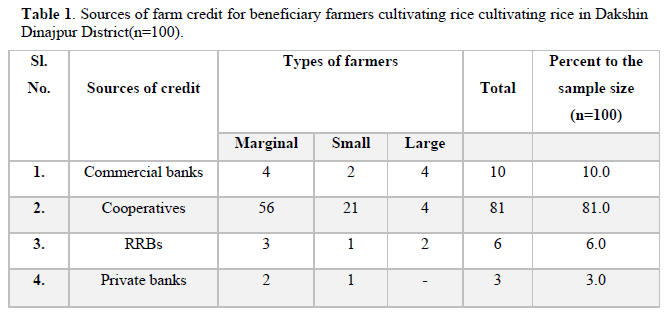
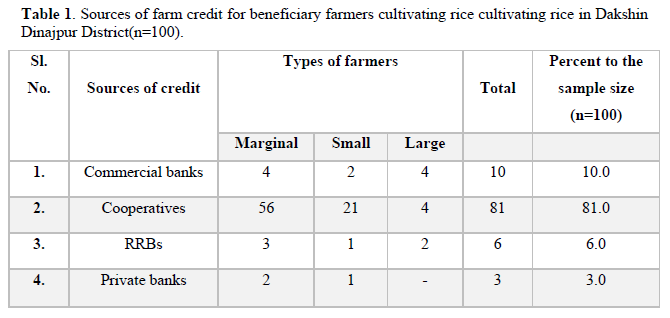
The sources of credit indicate the different channels available for the farmers to avail credit. All the sample farmers availed farm credit from different sources which are broadly classified under institutional sources and non-institutional sources. It could be inferred from Table 1 that the main source of farm credit availability to the farmers in the study area was the Primary Agricultural Credit Cooperative Societies (PACCS) which accounted for 81 per cent of the sample farmers. Similar findings were obtained from Mishra and Pattanaik (2005), Ijioma and Osondu (2015) and Pauline (2011) stated that cooperatives play primary roles in availing credit to the farmers. Commercial Banks (10 per cent) and Regional Rural Banks (6 per cent) also play significant roles in providing farm credit and the least role is undertaken by the Private Banks (3 per cent) in the study area.
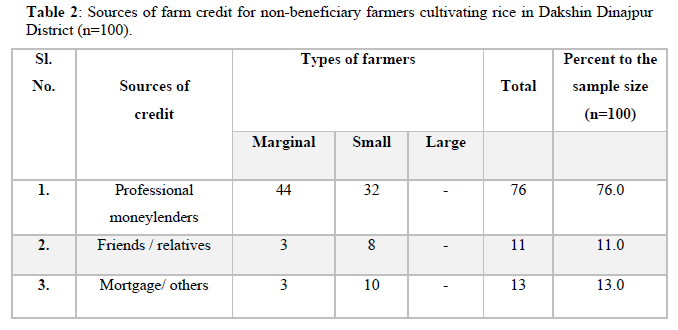
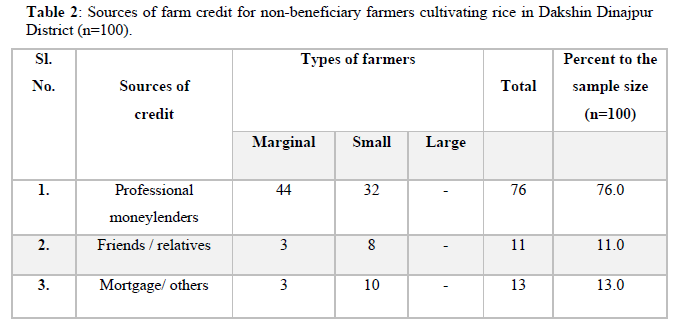
Small and marginal farmers were still under the grip of professional moneylenders, landlords for their farm credit needs by paying exorbitantly higher interest rates (Singh and Toor, 2005). From the Table 2 it is observed that, professional moneylenders occupy major share (76 per cent) in availing farm credit to small and marginal farmers followed by mortgage (13 per cent). Friends and relatives accounted for 11 per cent in providing credits to the respondent farmers.
Access to agricultural credit by farmers cultivating rice in Dakshin Dinajpur district
Rice farmers in Dakshin Dinajpur availed credit from both institutional sources (Commercial banks, Co-operatives, RRBs) and non-institutional sources (money lenders, commission agents, friends, relatives, landlords and financing companies). Per capita land holding plays a significant role in the magnitude and efficiency of production and income for the farm families. The average land holding size for marginal farmers was 0.45 ha, for small farmers were 1.13 ha and for large farmers was 2.29 ha., respectively, which constitute both beneficiary and non-beneficiary farmers.
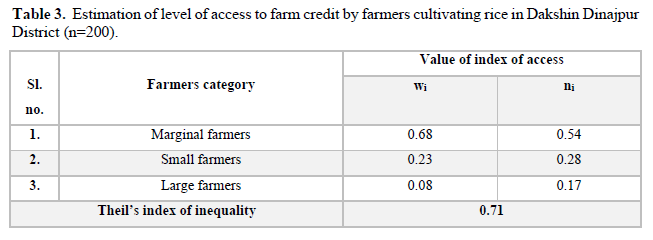
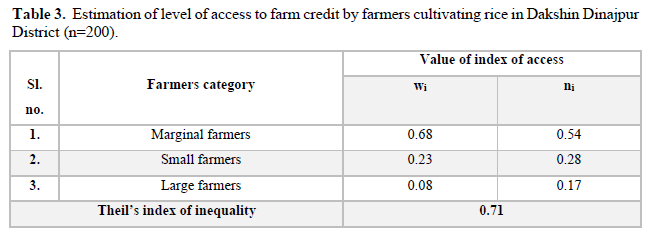
From the Table 3, it is recorded that that marginal farmers have higher access to agricultural credit (0.68, 0.54) in comparison to small farmers (0.23, 0.28) and large farmers (0.08, 0.17) in the study area. Marginal farmers have a relatively higher access to agricultural credit due to their low propensity to save. The results were found synonymous with Satyasai (2012). The Theil’s index of inequality obtained for estimating access to farm credit by marginal farmers, small farmers and large farmers was 0.71. This clearly indicates that the level of access to farm credit greatly varies among the marginal farmers, small farmers and large farmers in the study area.
Access to institutional and non-institutional farm credit sources by the farmers cultivating rice
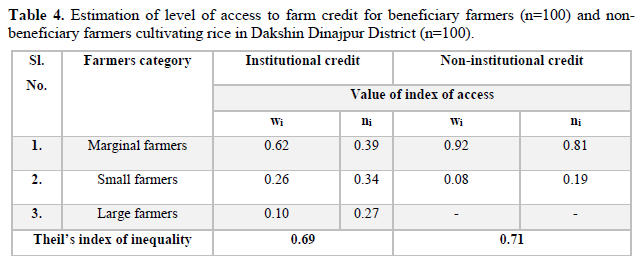
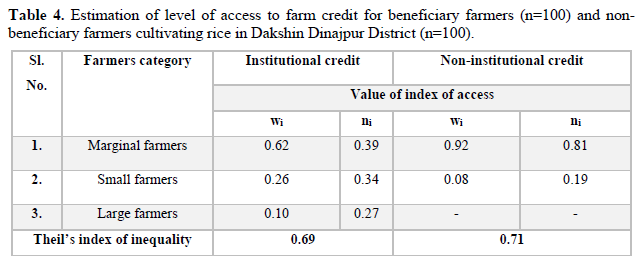
The index of access and Theil’s measure of inequality for beneficiary farmers cultivating rice were presented on Table 4. It is evident from the Table 4, that marginal farmers obtain higher index (0.62, 0.39) which clearly indicates that marginal farmers have more access to institutional credit sources because of their lower propensity to save, small land holding resulting to lower production and lesser income. For small farmers and large farmers, the estimated index value was (0.26, 0.34) and (0.10, 0.27), respectively, indicating that lesser access to institutional credit compared to marginal farmers because of higher income and higher propensity to save. The Theil’s index of inequality was 0.69 clearly indicating that access to institutional credit sources vary among the categories of beneficiary farmers cultivating rice.
The index of access and Theil’s measure of inequality for non-beneficiary farmers cultivating rice reveals that the marginal farmers are having higher index value (0.92, 0.81) clearly indicating that they have higher access to non-institutional sources because of lesser paper formalities, no proper land records, urgent requirement of credit, no guarantor involved even though the rate of interest is charged higher in non-institutional sources. For small farmers the index value was (0.08, 0.19) indicating lesser access to non-institutional credit compared to marginal farmers. The Theil’s index of inequality was found to be 0.71 which clearly shows that the access to non-institutional credit varies among the non-beneficiary farmers cultivating rice in Dakshin Dinajpur District.
Determinants of access to credit for farmers cultivating rice in Dakshin Dinajpur district
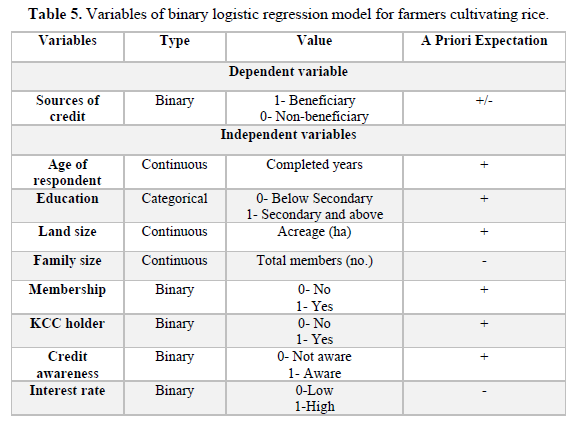
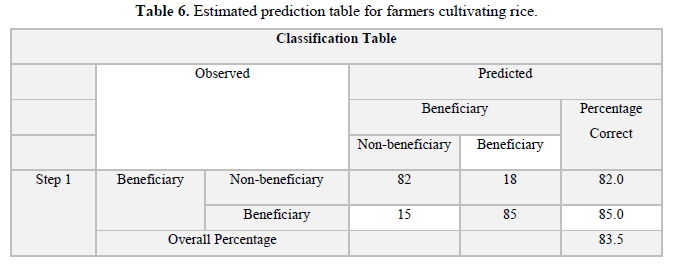
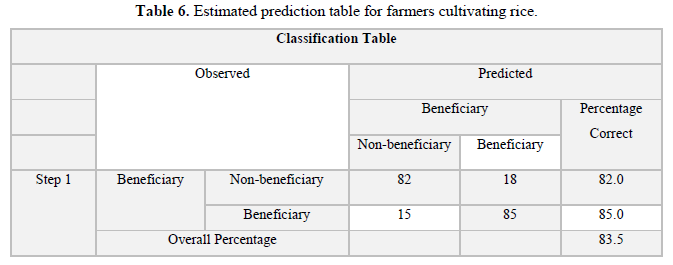
For the present analysis binary logit regression analysis is used. In Table 5, dependent variable is the sources of credit and independent variables such as age of respondent, level of education, size of landholdings, family size, group membership, Kishan credit card (KCC) holder, credit awareness and perception on interest rates charged by institutional and non-institutional sources were identified and hypothesized to explain the farmer’s decisions in accessing agricultural credit from various sources which includes both institutional and non-institutional sources prevailing in the study area. From Table 6, it can be concluded that 82 per cent of the non-beneficiary and 85 per cent of the beneficiary were correctly classified. Overall percentage of correct prediction for farmers cultivating rice is 83.5 per cent.
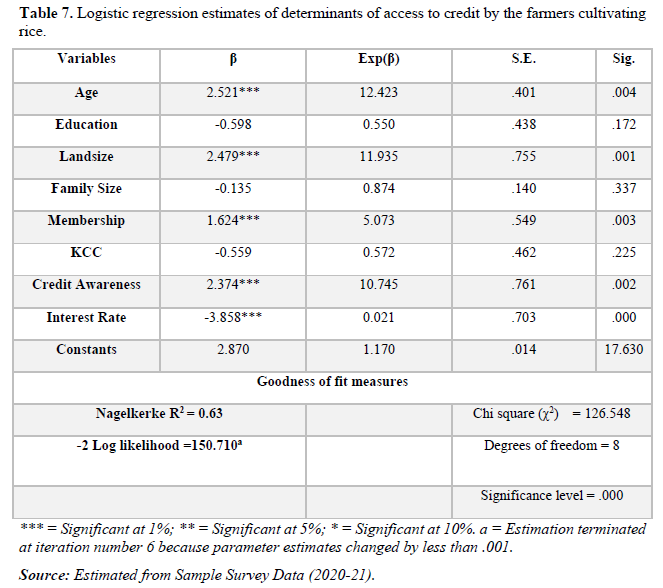
The estimated result of the logit regression model is presented on Table 7. The study findings highlighted that the age of respondent, size of landholdings, membership, credit awareness are significant and positively related while interest rate is found negatively significant to dependent variable.
From the Table 7, the estimated pseudo-R squared value is 0.63 implying that estimated equation is able to explain about 63 per cent of the variations of sample farmer’s decision regarding access to farm credit from lending institutes. The estimated log likelihood ratio value is 150.710 which is comparatively higher than the ꭓ2 value at 1 per cent probability for 8 degrees of freedom whose value is 20.090. This clearly shows that the slopes of the coefficients are statistically significant from zero.
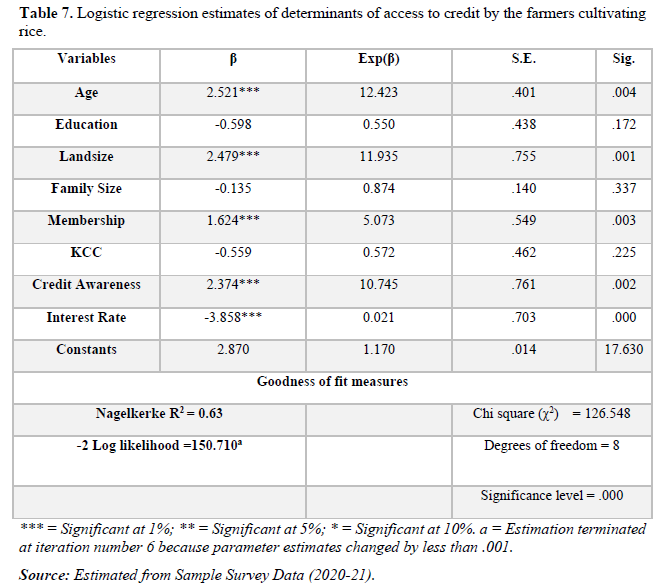
The study finding reveals that the age of the respondent is found to be positive (2.521) and significant at one per cent (0.004) level of significance. This clearly indicates that as the age of respondent increases the probability of credit access by the rice farmers implying that older farmers are assumed to have accumulated knowledge, experience in farm production activities and well informed about lending institutions. Similar results were observed in Hananuet al. (2015) and Akpan et al. (2013). The odds ratio (Exp β) of the age variable is equal to 12.423 indicating that access to credit will increase 12.42 times if the age of respondents increases by one unit. Therefore, the study concludes that the age of respondents plays a pivotal role in farmer’s decision of access to credit.
The study finding reveals that the size of landholdings of the respondent farmers is positively related (2.479) and significant at one per cent (0.001) level of significance. Land plays a pivotal role as collateral security for granting credit. Increase in farm size increases the demand for the factors of production i.e. labor, capital, improved seeds, fertilizers, equipments etc. which needs additional capital that can be obtained through agricultural credit. Similar results were stated by Oboh and Ekpebu (2011), Mwangi and Kariuki (2015). They concluded that access to credit services is primarily influenced by the size of farm that a household invest and adoption of new technologies which requires additional capital. The estimated odds ratio is 11.935 indicating that farmers with larger farm size have higher access for agricultural credit (11.93 times) than those with small farm size.
Membership to farmer’s cooperative society is found to have positive marginal effect on credit accessibility and significant at one per cent (0.003) level of significance. This clearly indicates that cooperative society membership is one of the key requirements for obtaining credit from lending institutes. This helps the institution to prevent cases of default or non-repayment among farmers. Formation of economic and social associations helps small farmers in improving access to agricultural credit since there is a joint guarantee by association members (Lawal et al. 2009). Also, the society members possess network connection, level of trust, collective action and mutual respect. The odds ratio of membership to farmer’s cooperative was 5.073 indicating that the farmers associated with membership in cooperative society have 5.07 times higher probability of accessing credit than those who don’t have membership association with farmer’s cooperative society.
The level of credit awareness by the respondent farmers in the study area is found to be statistically positive and significant at one per cent (0.002) level of significance. This clearly indicates that those farmers who have prior credit awareness have higher probability of accessing credit. The result of the study is synonymous with findings of Abraham (2014) revealing that adequate flow of information regarding awareness of credit lending institutes and procedures in accessing loans have higher influence on the smallholder farmers decision in accessing credit. The odds ratio for credit awareness is 10.745 indicating that the sample rice growing farmers who are well informed and aware on the availability of credit services, credit type, procedures and formalities of lending institutes are more likely to access agricultural credit 10.47 times more than those farmers with no information about credit facilities.
The study finding reveals that the famer’s perception on interest rate fulfills the priori expectation of negative relationship to credit access. Though, the result is negative but highly significant at one per cent (0.000) level of significance. The negative effect of interest rate reveals that credit schemes with higher interest rates lowers the probability of farmers access to agricultural credit and vice versa. The result is similar with the findings of Assogbaet al. (2017) stating that farmers are reluctant to credit schemes with higher interest rate. The odds ratio for interest rate was 0.021. The study concludes that rice farmers who perceived interest rates charged by the lending institutes to be high are less likely to access agricultural credit from those lending institutes. Moreover, financial institutes should provide loans at lower interest rates for ensuring that any farm credit obtained may be manageable for the farmers.
CONCLUSION
Agricultural credit plays a significant role in farm production over time. Inequitable access to agricultural credit across different farm-size classes and regions has remained an intractable problem with growing inequalities in access to credit. The present study has measured the access and degree of inequality in acquisition of credit vis-à-vis operated or cropped area. Ensuring that farmers towards adequate access to financial resources is a key component for successful rural development strategies. In a country which mostly relies on agriculture, constant endeavors are needed to see that rural and agricultural facilities are enhanced with the passage of time.

No Files Found


Internationally Accepted
Share Your Publication :