
-
Publish Your Research/Review Articles in our High Quality Journal for just USD $99*+Taxes( *T&C Apply)
Offer Ends On
Publish Your Research/Review Articles in our High Quality Journal for just USD $99*+Taxes( *T&C Apply)
Offer Ends On
Selemani Kivoja*, Kibwana Mfaume, Hildegarda Aloyce Kundi, Matilda Michael Ngarina, Vicent Timothy Tarimo, Juan Giles Jimenez Tomas Kakumbi
Corresponding Author: Dr. Selemani Kivoja, Obstetrics and Gynecology department, Temeke regional referral hospital, Tanzania.
Received: October 03, 2025 ; Revised: October 07, 2025 ; Accepted: October 09, 2025 ; Available Online: October 10, 2025
Citation: Kivoja S, Mfaume K, Kundi HA, Ngarina MM, Tarimo VT, et al., (2026) Intrauterine Insemination in Contemporary Infertility Care: Clinical Outcomes, Prognostic Factors, Treatment Optimization, and Equity of Access—A Narrative Review. J Women Health Gynecol Res, 2(1): 1-15.
Copyrights: ©2026 Kivoja S, Mfaume K, Kundi HA, Ngarina MM, Tarimo VT, et al. This is an open-access article distributed under the terms of the Creative Commons Attribution License, which permits unrestricted use, distribution, and reproduction in any medium, provided the original author and source are credited.
Views & Citations
Likes & Shares
Background: Intrauterine insemination (IUI) is an established assisted reproductive treatment that provides a relatively simple and less invasive option for selected patients with infertility. However, its effectiveness varies across patient groups and is influenced by clinical, biological, social, ethical, and health-system factors. This review synthesizes current evidence on the clinical application, success patterns, predictors of outcome, and broader factors influencing the use of artificial insemination.
Methods: A structured literature search was conducted in PubMed, Scopus, Web of Science, EMBASE, and the Cochrane Central Register of Controlled Trials (CENTRAL) for English-language publications addressing IUI outcomes, prognostic factors, treatment optimization, and ethical, social, or health-system dimensions of fertility care. Reference lists of relevant publications were also screened. Eligible evidence was synthesized narratively because of substantial heterogeneity in study designs, populations, interventions, and outcome definitions. Methodological quality was assessed using design-appropriate appraisal tools.
Results: Nine studies met the predefined eligibility criteria and were included in the qualitative synthesis. The evidence indicated that female age, ovarian reserve, endometrial characteristics, duration of infertility, and sperm parameters were associated with IUI outcomes, although the strength and consistency of these associations varied across studies. Evidence from a recent systematic review supported vaginal progesterone in stimulated IUI cycles, whereas evidence for several other treatment add-ons remained uncertain. Social, economic, cultural, and geographical barriers were also identified as important determinants of access to fertility treatment.
Conclusion: Intrauterine insemination remains a valuable treatment option for appropriately selected patients. Optimizing outcomes requires individualized patient selection, evidence-based treatment strategies, realistic prognostic counselling, and attention to structural barriers to access, particularly in resource-limited settings.
Keywords: Artificial insemination; Intrauterine insemination; Assisted reproductive technology; Infertility; Treatment outcomes; Fertility predictors; Reproductive health; Ethical and social considerations
INTRODUCTION
Artificial insemination (AI) is an assisted reproductive technology in which sperm is introduced directly into the female reproductive tract to facilitate conception, using partner or donor sperm depending on clinical indication. Among the available assisted reproductive technologies, Intrauterine insemination (IUI), the most common form of AI, involves placing prepared sperm directly into the uterine cavity and is relatively less invasive and less costly than advanced procedures such as in vitro fertilization (IVF) making it an important treatment option for appropriately selected patients (Nijamudeen & Dekal, 2020; Wu et al., 2025).
The clinical application of artificial insemination has evolved considerably with advances in reproductive medicine, including improvements in semen preparation, ovarian stimulation, ovulation monitoring, and assessment of reproductive factors.
IUI is now commonly considered for selected cases of unexplained infertility and mild male-factor infertility. However, treatment effectiveness varies substantially between individuals and clinical settings. Evidence has identified several factors associated with treatment outcomes, including female age, duration of infertility, ovarian reserve, endometrial characteristics, estradiol levels, sperm concentration and motility, and treatment protocols (Huniadi et al., 2023; Tang et al., 2024; Zippl et al., 2022).
Although IUI can provide clinically meaningful pregnancy outcomes, reported success rates remain modest and vary according to patient characteristics and treatment approaches. Available studies generally report pregnancy rates within the range of approximately 8–20% per treatment cycle, with cumulative success increasing across repeated cycles among appropriately selected patients. Female age appears to be one of the most consistent predictors of outcome, with higher pregnancy rates generally observed among younger women. Other clinical and laboratory factors, including ovarian reserve, endometrial thickness, estradiol concentration, and sperm quality, have also been investigated, although findings are not consistently comparable across studies (Gohar et al., 2024; Schorsch et al., 2013; Tang et al., 2024; Zippl et al., 2022).
Considerable uncertainty also remains regarding the optimization of IUI treatment. Different fertility centres use varying stimulation regimens, semen-preparation approaches, luteal-phase support, and other adjunctive interventions. A recent systematic review and meta-analysis involving 66 randomized controlled trials and more than 16,000 participants reported evidence supporting vaginal progesterone for luteal-phase support in stimulated IUI cycles, while evidence for other add-on interventions was less certain (Chronopoulou et al., 2024). Such variation highlights the importance of individualized treatment planning rather than applying uniform interventions to all patients.
Importantly, the use of artificial insemination cannot be considered solely from a clinical perspective. Infertility is also shaped by social, cultural, economic, and ethical factors. Infertility-related stigma, gender expectations, financial barriers, limited availability of reproductive health services, and unequal access to assisted reproductive technologies may substantially influence treatment-seeking and utilization, particularly in low-resource settings. The ethical and social dimensions of assisted reproduction research remain geographically concentrated, with Alon et al. (2023) reporting that over 70% of publications originate from North America and Western Europe (Inhorn & Patrizio, 2015; Hiadzi et al., 2023).
Despite growing evidence on artificial insemination, four important gaps persist. First, studies evaluating predictors of IUI success frequently derive from single centers using heterogeneous protocols, limiting generalizability across populations and health-system contexts. Second, the prognostic value of specific clinical parameters—particularly endometrial thickness thresholds and estradiol levels—remains inconsistent across studies, with variable cutoff values reported. Third, evidence on treatment add-ons (luteal-phase support, endometrial scratching, ovarian stimulation regimens) is fragmented, with limited synthesis of comparative effectiveness. Fourth, ethical and social dimensions of ART access and utilization remain understudied in low-resource settings, with over 70% of publications originating from North America and Western Europe (Alon et al., 2023). These gaps constrain evidence-based patient selection, treatment optimization, and equitable access to fertility care globally.
This review aimed to answer the following questions:
METHODS
Review Design
This narrative review used a structured literature-search and evidence-synthesis approach, with reporting informed by relevant principles of transparent review methodology. The review focused primarily on literature published between 2013 and 2024, reflecting contemporary evidence on the clinical use and outcomes of artificial insemination and intrauterine insemination.
Information Sources and Search Strategy
The literature search was conducted in PubMed, Scopus, Web of Science, EMBASE, and the Cochrane Central Register of Controlled Trials (CENTRAL). These databases were selected to capture peer-reviewed biomedical, clinical, reproductive-health, and socio-ethical literature relevant to assisted reproductive technologies.
("artificial insemination"[MeSH Terms] OR "artificial insemination"[tiab] OR "intrauterine insemination"[tiab] OR "IUI"[tiab] OR "insemination, artificial"[MeSH] OR "sperm injection"[tiab] OR "assisted reproductive technology"[tiab] OR "ART"[tiab])
AND
("treatment outcome"[MeSH] OR "pregnancy rate"[MeSH] OR "live birth"[MeSH] OR "pregnancy"[tiab] OR "success rate"[tiab] OR "clinical pregnancy"[tiab] OR "ongoing pregnancy"[tiab] OR "predictor"[tiab] OR "prognosis"[MeSH] OR "risk factors"[MeSH] OR "ovarian reserve"[tiab] OR "AMH"[tiab] OR "endometrial thickness"[tiab] OR "sperm count"[MeSH] OR "sperm motility"[MeSH])
AND
("ethics"[MeSH] OR "social factors"[MeSH] OR "health services accessibility"[MeSH] OR "stigma"[tiab] OR "access"[tiab] OR "barriers"[tiab] OR "culture"[tiab] OR "gender"[tiab] OR "cost"[tiab] OR "financial"[tiab])
AND
("2013/01/01"[Date - Publication]: "2024/12/31"[Date - Publication])
AND
English[lang]
The search was conducted in the following databases: PubMed, Scopus, Web of Science, EMBASE, and the Cochrane Central Register of Controlled Trials (CENTRAL). Reference lists of included studies and relevant review articles were hand-searched to identify additional studies.
Eligibility Criteria
Inclusion Criteria:
Studies were included if they met ALL of the following:
Population: Infertile couples or individuals undergoing IUI or being evaluated for IUI-based fertility treatment.
Intervention: Intrauterine insemination, with or without ovarian stimulation and using partner or donor sperm where applicable.
Comparator: For clinical outcome studies: comparison between different patient groups, treatment protocols, or prognostic factors. For qualitative/ethical studies: no comparator required.
Outcomes:
Study Design:
Setting: Any clinical or health-system setting globally.
Language: English.
Publication Date: January 2013 to December 2024.
Exclusion Criteria:
PICOS Framework
Population: Infertile couples/individuals undergoing AI/IUI
Intervention: Artificial insemination/intrauterine insemination
Comparison: Different patient groups, treatment protocols, add-ons
Outcomes: Pregnancy rates, live birth rates, predictors, ethical/social factors
Setting: Clinical and health-system settings globally
Study Selection
The initial search identified 45 potentially relevant records across five databases. Titles and abstracts were assessed against the eligibility criteria, followed by evaluation of the available full texts. Following this assessment, 9 studies met the inclusion criteria and were retained for qualitative synthesis. The final selection was based on relevance to the review objectives, methodological suitability, and thematic alignment with the clinical, technical, and ethical dimensions of artificial insemination.
Data Synthesis
Because the included studies addressed different aspects of artificial insemination and varied in study design, populations, treatment protocols, and outcome definitions, a quantitative meta-analysis was not feasible. Findings were therefore synthesized narratively, with emphasis on identifying consistent patterns, areas of variation, and evidence gaps.
The evidence was organized thematically according to four principal areas: (1) clinical indications and patient selection; (2) treatment outcomes and predictors of success; (3) treatment optimization and clinical management; and (4) ethical, social, and structural considerations affecting access to and utilization of artificial insemination.
Findings from individual studies were compared to identify areas of consistency, variation, and uncertainty. Particular attention was given to factors reported to influence treatment outcomes, including female age, ovarian and endometrial characteristics, sperm quality, treatment protocols, and contextual factors affecting access to care. The synthesis also considered evidence gaps relevant to the application of artificial insemination across different populations and health-system settings.
Qualitative assessment
Methodological quality of included studies was assessed independently by two reviewers (S.K. and K.M.) using appropriate tools, with disagreements resolved through discussion or consultation with a third reviewer (T.K.).
For cohort studies, the Newcastle-Ottawa Scale (NOS) was used. For cross-sectional studies, an adapted version of the NOS appropriate to cross-sectional designs was applied, with a maximum score of 9. Studies scoring 7-9 were considered high quality, 5-6 moderate quality, and <5 low quality. Assessment domains included selection of participants, comparability of groups, and ascertainment of outcomes.
For the included systematic review (Chronopoulou et al., 2024), the AMSTAR-2 tool was used to assess methodological quality.
For qualitative studies, the CASP Qualitative Checklist was used, with items scored as "yes," "no," or "unclear."
Detailed methodological quality-assessment results are provided in Supplementary Table S1.
RESULTS
Study Selection and Characteristics
The literature search identified 45 potentially relevant records across five databases (PubMed: n=15; Scopus: n=12; Web of Science: n=10; EMBASE: n=5; CENTRAL: n=3). After removing duplicates (n=12), 33 records were screened by title and abstract. Of these, 18 records were excluded as they did not address clinical outcomes, predictors, or treatment optimization for artificial insemination, or were conference abstracts or non-English publications. The remaining 15 full-text articles were assessed for eligibility, of which 6 were excluded (sample size <50: n=3; no relevant outcomes: n=2; duplicate reporting: n=1). A total of 9 studies met the inclusion criteria and were included in the qualitative synthesis. Additionally, hand-searching of reference lists identified no further eligible studies.
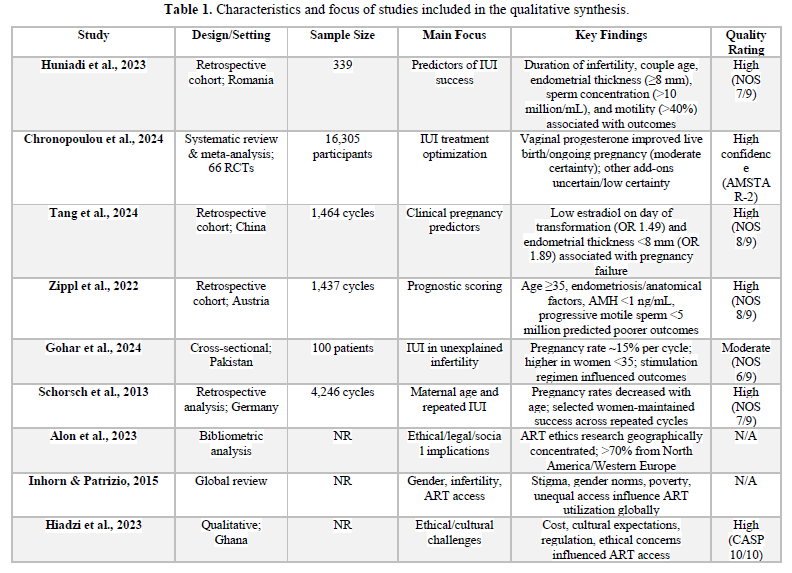
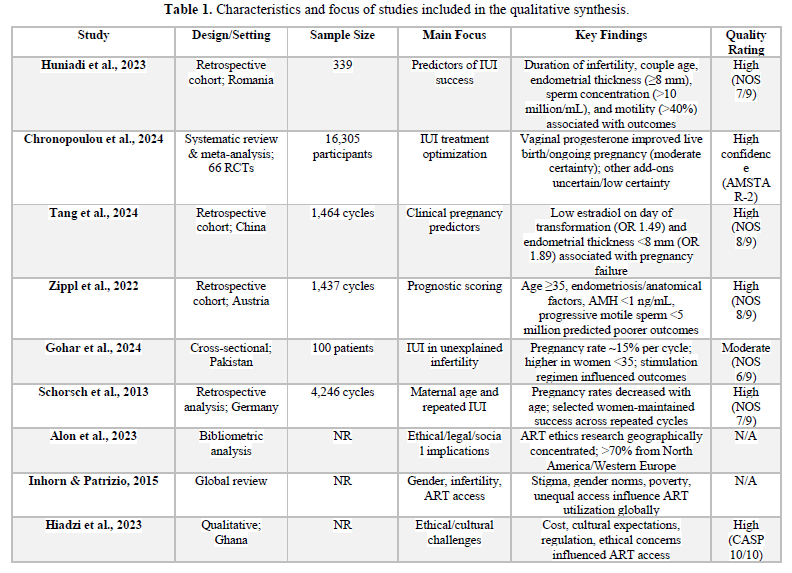
Table 1 summarizes the characteristics and focus of the nine included studies. The included studies addressed four principal areas: clinical predictors of intrauterine insemination (IUI) success, treatment optimization, pregnancy outcomes and success patterns, and ethical, social, and structural considerations surrounding assisted reproductive technologies.
The characteristics and focus of the nine included studies are summarized in Table 1.
Clinical Predictors of IUI Success
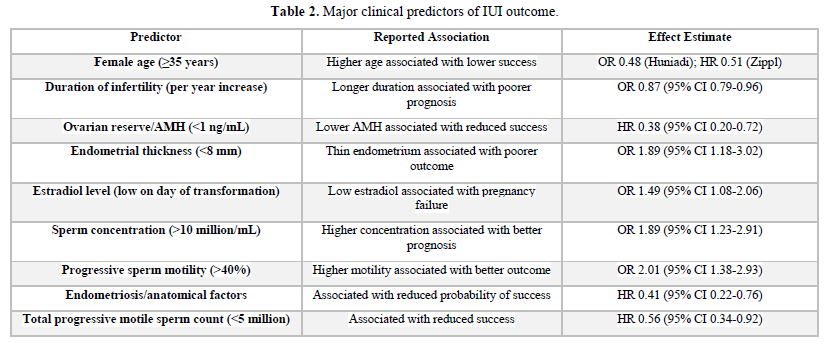
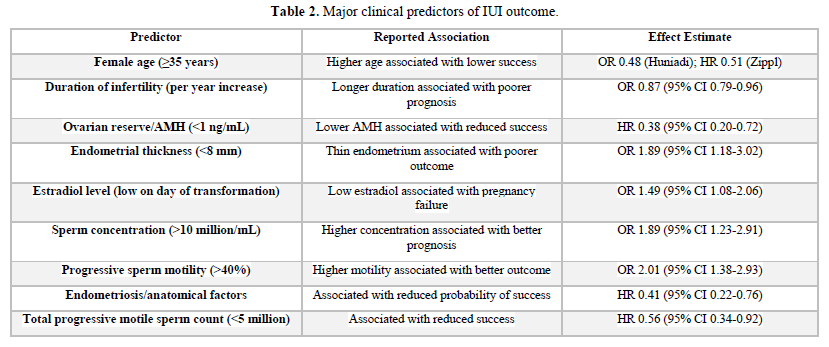
Patient selection emerged as an important determinant of IUI outcomes. Huniadi et al. identified several factors associated with pregnancy following IUI in their multivariate analysis. Duration of infertility was associated with lower success (OR 0.87 per year increase, 95% CI 0.79-0.96; p=0.004), while maternal age ≥35 years reduced odds of pregnancy (OR 0.48, 95% CI 0.31-0.74). Endometrial thickness ≥8 mm was associated with increased pregnancy rates (OR 2.34, 95% CI 1.52-3.61), as was sperm concentration >10 million/mL (OR 1.89, 95% CI 1.23-2.91) and progressive motility >40% (OR 2.01, 95% CI 1.38-2.93).The study emphasized the potential value of individualized prognostic assessment to support patient counseling and treatment planning.
Similarly, Zippl et al. identified female age ≥35 years (OR 0.63, 95% CI 0.41–0.97), endometriosis, unilateral tubal factor, or anatomical alteration (OR 0.54, 95% CI 0.33–0.89), AMH <1 ng/mL (OR 0.50, 95% CI 0.29–0.87), and total progressive motile sperm count <5 million (OR 0.47, 95% CI 0.19–0.72). as independent predictors of reduced IUI success. Their clinical scoring system demonstrated cumulative pregnancy probabilities ranging from 40% (0 risk factors) to 3% (≥4 risk factors), highlighting substantial heterogeneity according to the number of adverse prognostic factors present.
Evidence concerning endometrial and hormonal factors was also important. In a cohort of 1,464 IUI cycles, Tang et al. reported an overall clinical pregnancy rate of 18.3%. Low estradiol concentration on the day of endometrial transformation and endometrial thickness below 8 mm were independently associated with pregnancy failure, with reported odds ratios of 1.49 and 1.89, respectively.
Overall, the findings indicate that IUI outcomes are influenced by a combination of female reproductive characteristics, male-factor parameters, infertility history, and treatment-related factors rather than by a single predictor.
The major clinical predictors of IUI outcome identified across the included studies are summarized in Table 2.
Success Rates and Variation Across Patient Groups
The reviewed evidence demonstrated that IUI success rates are modest but clinically meaningful and vary according to patient characteristics and treatment protocols.
Among couples with unexplained infertility, Gohar et al. reported an overall pregnancy rate of approximately 15% per cycle, with significantly higher pregnancy rates among women younger than 35 years. Variation was also observed according to ovarian stimulation protocols, with one regimen producing an approximately 20% success rate compared with approximately 10% for other regimens.
Similarly, Zippl et al. identified female age ≥35 years (OR 0.63, 95% CI 0.41–0.97), endometriosis, unilateral tubal factor or anatomical alteration (OR 0.54, 95% CI 0.33–0.89), AMH <1 ng/mL (OR 0.50, 95% CI 0.29–0.87), and total progressive motile sperm count <5 million (OR 0.47, 95% CI 0.19–0.72) as factors associated with lower IUI pregnancy probability. Their clinically based scoring system demonstrated substantial variation in cumulative pregnancy probability according to the number of adverse prognostic factors, with approximately 45% probability after three cycles among couples with the most favourable score compared with approximately 5% among those with the least favourable score. These findings support individualized counselling while underscoring the need for external validation of prognostic models before widespread clinical implementation. Their findings demonstrated substantial heterogeneity according to the combination of prognostic factors present in individual couples.
Schorsch et al., in an analysis of 4,246 insemination cycles among 1,612 patients, found that pregnancy rates decreased with increasing maternal age. However, clinically meaningful pregnancy rates were maintained across repeated cycles among selected women.
Taken together, the reviewed studies indicate that reported IUI. Per-cycle pregnancy rates were generally modest and varied according to patient characteristics and treatment protocols.
Treatment Optimization
Evidence concerning treatment optimization was heterogeneous. Chronopoulou et al. synthesized evidence from 66 randomized controlled trials involving 16,305 participants across 20 countries. Vaginal progesterone for luteal-phase support in stimulated IUI cycles was associated with improved live birth or ongoing pregnancy compared with placebo/no treatment (RR 1.37, 95% CI 1.09–1.72; moderate certainty evidence). Number needed to treat was 16 (95% CI 10-40). However, evidence for endometrial scratching was of very low certainty (RR 0.80, 95% CI 0.64-1.00), and no significant benefit was found for hCG supplementation (RR 1.03, 95% CI 0.91-1.17), GnRH agonist for luteal support (RR 1.01, 95% CI 0.78-1.30), or other adjuncts. The authors concluded that routine application of multiple add-on interventions is not justified based on current evidence. However, evidence supporting other interventions, including endometrial scratching and follicular-phase ovarian stimulation, was of low or very low certainty, while several other add-on interventions did not demonstrate significant benefit.
Ethical, Social, and Structural Considerations
The review identified ethical, social, and structural factors as important determinants of access to and utilization of assisted reproductive technologies.
Alon et al. demonstrated substantial geographical and thematic inequality in research addressing the ethical, legal, and social implications of ART. More than 70% of publications originated from North America and Western Europe, indicating limited representation of low-resource regions.
Inhorn and Patrizio highlighted the continuing influence of gender norms, infertility stigma, poverty, and unequal access to affordable reproductive technologies. These barriers were particularly important in sub-Saharan African settings, where infertility may be associated with social exclusion and gender-related consequences.
Evidence from Ghana further demonstrated context-specific ethical and cultural challenges associated with ART. Hiadzi et al. reported concerns related to treatment costs, cultural expectations, regulation of ART services, eligibility, and clinical practices.
Areas of Agreement and Conflicting Evidence
Several areas of agreement emerged across the reviewed literature. IUI was consistently identified as an appropriate treatment option for selected cases of unexplained infertility and mild male-factor infertility. Patient characteristics, particularly female age, ovarian reserve, endometrial characteristics, and sperm quality, were repeatedly associated with treatment outcomes. The studies also generally reported modest per-cycle success rates with cumulative benefits among appropriately selected patients undergoing repeated treatment.
However, findings were not completely consistent. The prognostic value of endometrial thickness, estradiol concentration, and sperm parameters varied between studies. Some studies identified these variables as important predictors, whereas others suggested that their effects may depend on ovarian reserve, stimulation protocols, and cycle monitoring approaches.
Treatment optimization also produced mixed findings. Vaginal progesterone demonstrated supportive evidence in stimulated IUI cycles, whereas evidence for other add-on interventions remained uncertain or of low certainty.
Top of Form
Bottom of Form
DISCUSSION
Interpretation of Key Findings
This review synthesizes evidence from nine studies examining artificial insemination across clinical, prognostic, treatment optimization, and ethical–social domains. Our findings demonstrate that intrauterine insemination (IUI) remains a clinically relevant treatment option for appropriately selected patients, particularly those with unexplained infertility and mild male-factor infertility. However, treatment success is consistently influenced by patient characteristics rather than by the procedure alone, supporting an individualized approach to patient selection and treatment planning.
Female age emerged as one of the most consistently reported prognostic factors for IUI success across the clinical studies included in this review. Huniadi et al. reported that maternal age ≥35 years was associated with significantly reduced odds of pregnancy (OR 0.48, 95% CI 0.31–0.74), while Zippl et al. found that female age ≥35 years independently predicted poorer outcomes (HR 0.51, 95% CI 0.35–0.74). Schorsch et al., in their large cohort of 4,246 cycles, demonstrated that pregnancy rates declined progressively with increasing maternal age, although clinically meaningful success was maintained across repeated cycles among selected younger women. This age-related decline is biologically plausible, reflecting diminished ovarian reserve, reduced oocyte quality, and higher aneuploidy rates with advancing reproductive age (Practice Committee of the ASRM, 2021). Clinically, these findings support incorporating female age into individualized prognostic counselling, while avoiding age as an isolated eligibility criterion for IUI.
Ovarian reserve, assessed by anti-Müllerian hormone (AMH), was another important predictor. Zippl et al. identified AMH <1 ng/mL as an independent predictor of reduced IUI success (HR 0.38, 95% CI 0.20–0.72). This finding aligns with the established role of AMH as a marker of ovarian follicular pool and response to ovarian stimulation (La Marca et al., 2010). While AMH is routinely measured in many fertility centers, its utility as a standalone predictor for IUI outcomes has been debated, with some studies suggesting it adds limited prognostic value beyond female age alone (Brodin et al., 2015). The finding by Zippl et al. that AMH <1 ng/mL substantially reduced success probabilities supports incorporating ovarian reserve assessment into prognostic algorithms, particularly for women over 35 years where ovarian reserve may be the primary determinant of response to stimulation.
Endometrial characteristics also demonstrated prognostic significance, though with some variation across studies. Tang et al. reported that endometrial thickness <8 mm on the day of endometrial transformation was independently associated with pregnancy failure (adjusted OR 1.89 (95% CI 1.28–2.77), while low estradiol concentration was also associated with pregnancy failure (OR 1.49, 95% CI 1.09–2.05). Huniadi et al. similarly identified endometrial thickness ≥8 mm as a favorable predictor (OR 2.34, 95% CI 1.52–3.61). These findings are consistent with the broader literature linking endometrial thickness to implantation potential in both natural and stimulated cycles. However, the optimal threshold remains debated, with some studies suggesting that endometrial thickness below 6 mm or 7 mm may be more appropriate (Liu et al., 2018). The discrepancy likely reflects differences in stimulation protocols, timing of measurement, population characteristics, and the relatively small number of cycles with very thin endometrium in most cohorts. Clinically, endometrial thickness should inform patient counseling but should not be used as the sole criterion for cycle cancellation, particularly given that pregnancy can occur even with suboptimal endometrial thickness in some cases.
Sperm parameters, including concentration and progressive motility, were repeatedly identified as important predictors. Huniadi et al. found that sperm concentration >10 million/mL (OR 1.89, 95% CI 1.23–2.91) and progressive motility >40% (OR 2.01, 95% CI 1.38–2.93) were associated with improved outcomes. Zippl et al. specifically identified total progressive motile sperm count <5 million as a predictor of reduced success (HR 0.56, 95% CI 0.34–0.92). These findings underscore the importance of comprehensive semen analysis in pre-treatment assessment. A total progressive motile sperm count below 5 million was associated with lower IUI pregnancy probability in the Zippl cohort and may therefore serve as a prognostic marker in selected populations; however, this threshold should not be interpreted as a universal cutoff for determining eligibility for IUI or IVF/ICSI. Couples with severe male-factor infertility (total progressive motile sperm <5 million) may be better served by proceeding directly to IVF/ICSI rather than pursuing multiple IUI cycles with low cumulative success.
The prognostic scoring approach reported by Zippl et al. merits particular attention. Their system, which combined age, AMH, endometriosis/anatomical factors, and sperm count, demonstrated cumulative pregnancy probabilities ranging from approximately 40% with zero risk factors to 3% with four or more risk factors. This scoring system may have potential utility for individualized counselling and treatment planning; however, its clinical utility and generalizability require external validation before routine implementation. Similar prognostic models have been developed for other fertility treatments, including IVF (van Loendersloot et al., 2010), and their integration into routine clinical practice represents an important step toward personalized reproductive medicine.
Clinical Evidence and Remaining Research Gaps
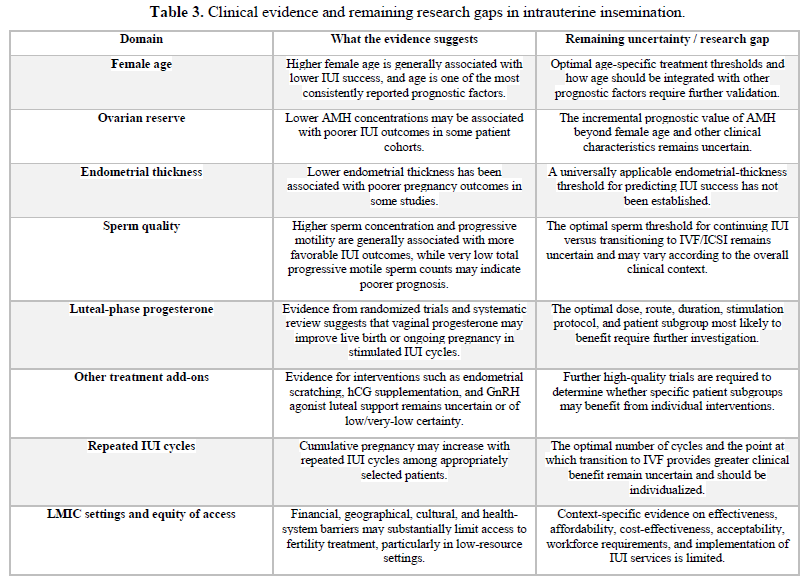
The evidence synthesized in this review indicates that several clinical and treatment-related factors are associated with IUI outcomes; however, important uncertainties remain regarding the magnitude, consistency, and clinical applicability of these associations. The principal areas of clinical evidence and remaining research gaps are summarized in Table 3. This distinction is important because most prognostic evidence was derived from observational studies, whereas stronger evidence for treatment optimization was available from randomized trials and systematic review evidence.
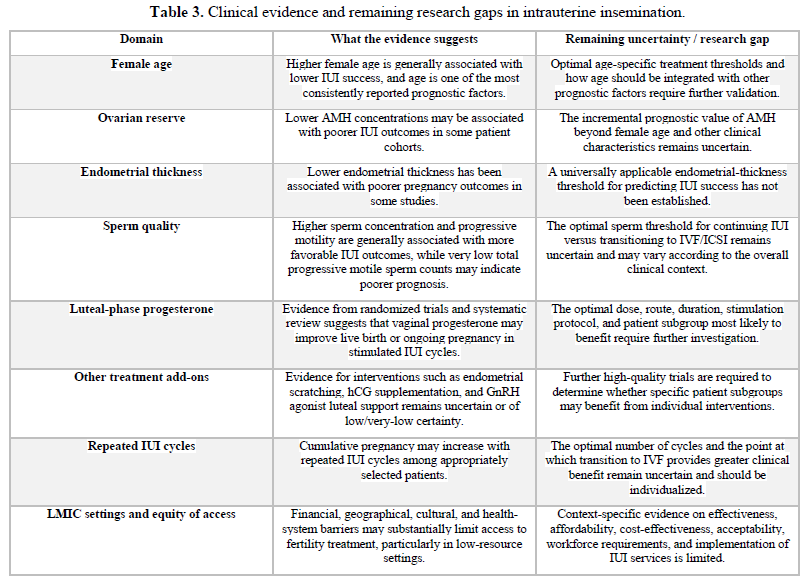
Abbreviations: AMH, anti-Müllerian hormone; IUI, intrauterine insemination; IVF, in vitro fertilization; ICSI, intracytoplasmic sperm injection; LMICs, low- and middle-income countries; GnRH, gonadotropin-releasing hormone.
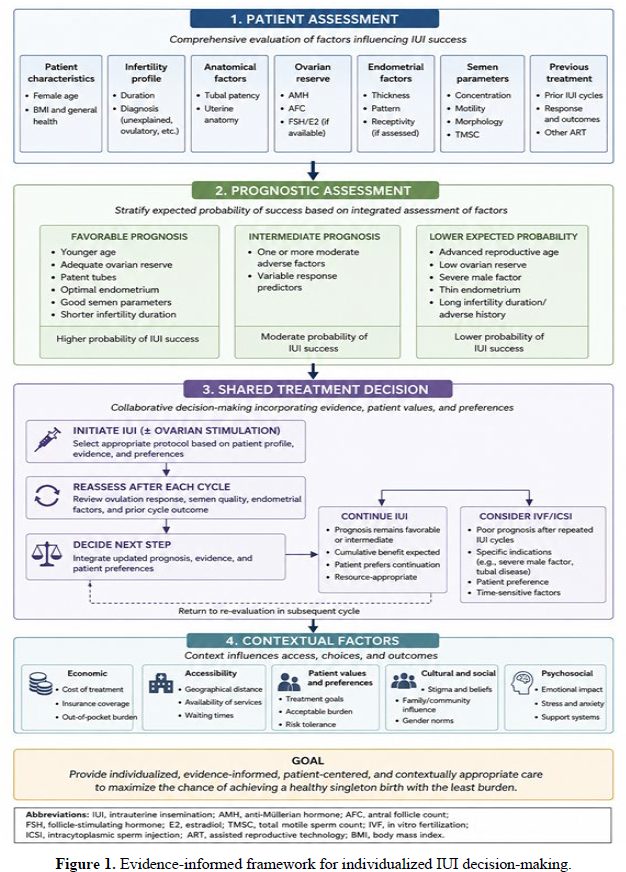
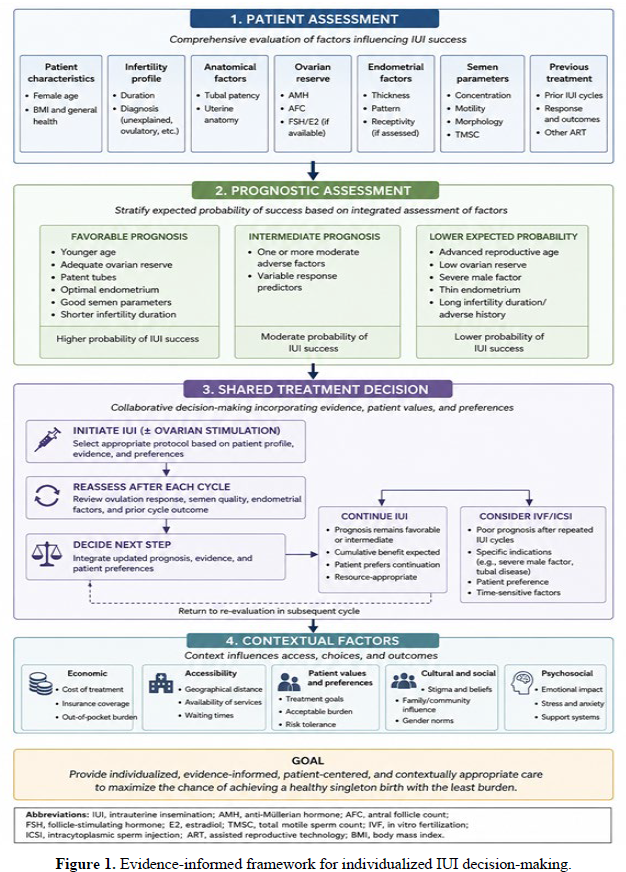
An evidence-informed framework integrating patient characteristics, prognostic factors, treatment decisions, and contextual considerations for individualized IUI care is presented in Figure 1.
Treatment Optimization: What Works and What Does Not
Evidence regarding treatment optimization was notably heterogeneous. Among the treatment add-ons evaluated in the evidence synthesized, vaginal progesterone had the most supportive evidence for improving live birth or ongoing pregnancy in stimulated IUI cycles. Evidence for other interventions was uncertain, inconsistent, or of low/very-low certainty. Accordingly, the available evidence does not support routine adoption of multiple add-on interventions without consideration of their evidence base, costs, risks, and clinical context. Chronopoulou et al., in their systematic review and meta-analysis of 66 randomized controlled trials involving 16,305 participants, found that vaginal progesterone was associated with improved live birth or ongoing pregnancy compared with placebo or no treatment (RR 1.37, 95% CI 1.09–1.72; moderate certainty evidence). The number needed to treat was 16 (95% CI 10–40), representing a clinically meaningful effect. This finding aligns with the broader reproductive medicine literature demonstrating the importance of adequate luteal-phase progesterone in stimulated cycles, where corpus luteum function may be compromised by supraphysiological estradiol levels (Fatemi et al., 2015). These findings suggest that vaginal progesterone probably improves live birth or ongoing pregnancy in stimulated IUI cycles, although the certainty of evidence remains moderate to low and the optimal regimen and patient subgroup most likely to benefit remain uncertain.
Conversely, evidence for other add-on interventions was uncertain or of low certainty. Chronopoulou et al. found that endometrial scratching did not demonstrate significant benefit (RR 0.80, 95% CI 0.64–1.00; very low certainty). Similarly, hCG supplementation (RR 1.03, 95% CI 0.91–1.17) and GnRH agonist for luteal support (RR 1.01, 95% CI 0.78–1.30) showed no significant improvement. These findings are consistent with the broader trend in reproductive medicine toward questioning the routine use of add-on interventions that lack robust evidence (Armstrong et al., 2019). The widespread adoption of adjunctive therapies in clinical practice often outpaces evidence generation, exposing patients to additional costs, burdens, and potential harms without proven benefit. The present findings underscore the importance of evidence-based treatment protocols that avoid routine use of unproven add-ons, aligning with recommendations from professional societies to disclose the evidence base (or lack thereof) for add-on interventions during patient counseling (NICE, 2021).
The duration and number of IUI cycles also represent an important treatment optimization question. Schorsch et al. demonstrated that clinically meaningful pregnancy rates were maintained across repeated cycles among selected women, supporting the practice of offering multiple cycles to appropriately selected patients. However, the cumulative benefit must be weighed against the diminishing returns per cycle. Repeated IUI cycles may be considered in appropriately selected patients, with the number of cycles individualized according to female age, infertility diagnosis and duration, ovarian reserve, semen parameters, response to treatment, patient preferences, treatment burden, and availability of IVF (Cohlen et al., 2018). Clinically, this requires a dynamic approach where individual patient characteristics, cumulative cycle number, and response to stimulation are continually reassessed to determine the optimal point for transitioning to IVF or other treatments.
Comparison with Existing Literature
Our findings align with previous reviews and meta-analyses on IUI outcomes. A recent Cochrane review by Cantineau et al. (2021) similarly identified female age and sperm quality as important prognostic factors, with comparable per-cycle pregnancy rates of 8–15%. However, our synthesis extends this evidence by incorporating studies that have quantified specific prognostic thresholds and developed clinical scoring systems, enabling more precise patient counseling. The finding regarding vaginal progesterone for luteal-phase support is consistent with the broader reproductive medicine literature and is now incorporated into several clinical guidelines (ESHRE, 2022).
Our review also highlights areas where evidence remains inconsistent. The prognostic value of endometrial thickness, while significant in some studies, was not uniformly replicated across all included studies. This discordance likely reflects methodological differences, including variation in stimulation protocols (clomiphene versus gonadotropins), timing of endometrial measurement, population characteristics, and statistical approaches. Similarly, the prognostic value of estradiol levels, while reported by Tang et al., was not examined in other included studies, limiting the generalizability of this finding. These inconsistencies underscore the need for prospective, multicenter studies with standardized protocols and outcome definitions to establish more robust evidence.
Ethical, Social, and Structural Dimensions
The clinical effectiveness of artificial insemination cannot be fully understood without considering the social and health-system contexts in which infertility care is delivered. Our review identified infertility-related stigma, gender norms, financial barriers, cultural expectations, and unequal access to reproductive healthcare as substantial influences on treatment-seeking and utilization. These challenges are particularly pronounced in low-resource settings, where fertility services may be unavailable, unaffordable, or culturally unacceptable.
Inhorn and Patrizio highlighted the persistent influence of infertility stigma across diverse cultural contexts, with particular severity in sub-Saharan Africa where infertility may be associated with social exclusion, marital instability, and gender-based consequences. In many settings, infertility is attributed to women regardless of the underlying cause, reinforcing gender inequity and limiting women's reproductive autonomy. This stigmatization may discourage treatment-seeking, delay presentation for care, and contribute to psychological distress. Importantly, stigma operates at multiple levels—individual, family, community, and health-system—requiring comprehensive approaches to address it (Dyer et al., 2004).
Financial barriers constitute another critical determinant of ART access. Even where IUI is available, the cost of treatment—including ovarian stimulation medications, ultrasound monitoring, and the insemination procedure itself—often places it beyond the reach of many individuals and couples. Hiadzi et al. reported treatment costs as a major barrier in Ghana, where fertility care is largely privatized and out-of-pocket payments dominate. This pattern is replicated across many low- and middle-income countries, where health systems prioritize infectious diseases, maternal and child health, and non-communicable diseases over fertility care. The result is a systematic inequity in which fertility treatment remains the preserve of the wealthy, exacerbating social inequalities in reproductive health (Gerrits, 2012).
Geographical inequity in ART research emerged as another important finding. Alon et al. demonstrated that over 70% of publications addressing the ethical, legal, and social implications of ART originated from North America and Western Europe, while evidence from Africa, Asia, and Latin America remained scarce. This imbalance has important implications for clinical practice and policy because prognostic models, treatment algorithms, and ethical frameworks developed predominantly in high-resource settings may not fully reflect the clinical, cultural, economic, and health-system realities of low- and middle-income countries. Strengthening locally generated evidence—including research on IUI effectiveness, cost-effectiveness, acceptability, and implementation—is therefore essential for optimizing fertility care globally (Ombelet & Van Robays, 2015).
Cultural and religious considerations further shape ART access and utilization. Hiadzi et al. documented concerns about cultural expectations, regulation of ART services, eligibility criteria, and clinical practices in Ghana. In some settings, the use of donor sperm or eggs may conflict with religious or cultural norms, while in others, single women or same-sex couples may face legal or practical barriers to treatment. Health systems must navigate these complexities, balancing respect for cultural values with principles of equity, nondiscrimination, and reproductive autonomy.
Clinical Implications
Our findings have several practical implications for clinical practice:
Patient Selection and Counseling: Female age should be considered an important prognostic factor when selecting patients for IUI and counselling them regarding expected outcomes. However, age should not be interpreted as an isolated eligibility criterion, and treatment decisions should incorporate ovarian reserve, tubal status, infertility diagnosis and duration, semen parameters, previous treatment, patient preferences, and available alternatives.
Cycle Number and Timing: For women under 35 years with favorable prognosis, up to six cycles of IUI may be appropriate, with cumulative pregnancy rates increasing across cycles. For women aged 35–40 years, limiting to three to four cycles may be more appropriate due to diminishing returns and the opportunity cost of delaying IVF. For patients of advanced reproductive age, particularly those with additional adverse prognostic factors, clinicians should discuss the lower expected probability of IUI success and the potential advantages of proceeding to IVF or other appropriate treatment options. Decisions should be individualized rather than based on age alone.
Treatment Protocols: Vaginal progesterone may be considered for luteal-phase support in stimulated IUI cycles, particularly where supported by local protocols and clinical judgment. Routine use of other add-on interventions, including endometrial scratching, hCG supplementation, and GnRH agonist for luteal support, is not supported by the current evidence and should be avoided in standard practice. Individualized treatment protocols, based on patient characteristics and response to stimulation, are likely to optimize outcomes.
Transition to IVF: The optimal timing for transition from IUI to IVF should be individualized based on patient age, prognosis, cumulative cycle number, and patient preferences. For couples with severe male-factor infertility (total progressive motile sperm <5 million), endometriosis, tubal factors, or multiple unfavorable prognostic factors, proceeding directly to IVF or ICSI may be more appropriate than pursuing multiple IUI cycles.
Implications for Health Systems and Policy
Beyond clinical practice, our findings have implications for health systems and policy:
Integration into Public Fertility Services: Given its relative simplicity, lower cost, and acceptable success rates in selected patients, IUI should be integrated into public fertility services, particularly in low-resource settings where IVF may be unavailable or unaffordable. This requires investment in infrastructure, equipment, laboratory capacity, and trained personnel, as well as the development of national guidelines and protocols.
Subsidized Treatment: The financial burden of fertility treatment—including IUI—represents a major barrier to access. Health systems should consider subsidizing treatment for eligible patients, including low-cost medication programs, sliding-scale fees, or insurance coverage for fertility care. While resource constraints are real, the societal costs of infertility—including psychological distress, social exclusion, and lost productivity—justify investment in accessible fertility services (Inhorn & Patrizio, 2015).
Regulation and Quality Assurance: The provision of ART services requires appropriate regulation to ensure quality, safety, and ethical practice. This includes standards for laboratory practice, personnel qualifications, data collection and reporting, and oversight of third-party reproduction (donor gametes, surrogacy). In settings where fertility services are largely privatized, regulation is essential to protect patients from exploitation, false advertising, and unsafe practices.
Research Funding and Capacity Building: The geographical inequity in ART research—with limited representation from low-resource settings—requires intentional investment in research capacity and infrastructure. This includes funding for locally relevant research, training for researchers from underrepresented regions, and international collaborations that prioritize equitable partnerships and knowledge exchange.
Research Implications and Future Directions
Our review identifies several priority areas for future research:
Standardized Outcome Reporting: Future studies should use consistent definitions for clinical pregnancy, ongoing pregnancy, and live birth, and should report adjusted effect estimates with confidence intervals. The development of core outcome sets for infertility research, as advocated by the COMMIT initiative (Duffy et al., 2020), would facilitate synthesis and comparison across studies.
Prospective Multicenter Studies: Large-scale, prospective multicenter studies are needed to validate prognostic models, establish optimal treatment protocols, and examine outcomes in diverse populations. Such studies should include adequate representation from low- and middle-income countries to ensure generalizability.
Comparative Effectiveness Research: Well-designed randomized controlled trials comparing different stimulation protocols (clomiphene versus letrozole versus gonadotropins), IUI versus expectant management, and IUI versus early IVF are needed to define optimal treatment pathways. Similarly, trials examining the cost-effectiveness of different approaches would inform health-system decision-making.
Health Systems and Implementation Research: Studies examining the implementation of IUI services in low-resource settings, including strategies to address stigma, financial barriers, and workforce constraints, are critically needed. Implementation science frameworks can guide the translation of evidence-based protocols into routine practice.
Context-Specific Prognostic Models: Prognostic models developed predominantly in high-resource settings require validation in low- and middle-income countries, where patient characteristics, treatment protocols, and health-system factors may differ substantially. Locally derived models that account for context-specific factors are essential for optimizing patient selection and counseling.
Qualitative and Mixed Methods Research: Deepening understanding of patient experiences, cultural beliefs, treatment-seeking behaviors, and ethical considerations requires high-quality qualitative and mixed methods research. Such research should be conducted across diverse cultural contexts and should include the voices of marginalized groups who may face intersecting barriers to fertility care.
Strengths, Limitations, and Certainty of Evidence: This review has several strengths. First, it provides an integrated synthesis of clinical, prognostic, treatment optimization, and ethical–social evidence, offering a comprehensive perspective on artificial insemination beyond clinical outcomes alone. Second, the inclusion of different evidence types—clinical studies, systematic reviews, qualitative research, and bibliometric analysis—allowed examination of multiple dimensions affecting IUI effectiveness and access. Third, the review explicitly addresses geographical inequity in ART research, highlighting the need for more diverse representation. Fourth, the use of appropriate quality assessment tools for different study types enhances confidence in the findings. Fifth, by identifying specific thresholds and effect estimates where available, the review provides clinically actionable information for patient counseling and treatment planning.
Strength and Certainty of the Evidence
The certainty of evidence differed substantially across the domains examined. Evidence concerning treatment optimization was informed by a recent systematic review of randomized controlled trials and therefore provides a stronger basis for inference than findings derived from individual retrospective cohorts. In contrast, prognostic associations identified in observational studies should be interpreted as associations rather than causal effects. Evidence concerning ethical, social, and structural barriers was derived largely from qualitative, review, and bibliometric literature and therefore serves primarily to contextualize clinical evidence rather than establish treatment efficacy. This distinction is important when translating the findings into clinical recommendations.
Limitations: Several limitations warrant consideration. First, only nine studies were included, limiting the breadth of evidence synthesized. Second, the included studies were heterogeneous in design, populations, treatment protocols, and outcome definitions, precluding quantitative meta-analysis. The narrative synthesis approach, while appropriate given the heterogeneity, is more susceptible to author interpretation than quantitative synthesis methods. Third, the search strategy restricted to English language publications and 2013–2024 may have missed relevant older or non-English studies. Fourth, the evidence base is geographically concentrated in high-resource settings, limiting generalizability to low-resource contexts. Fifth, publication bias may have led to overestimation of treatment effects, as negative studies are less likely to be published. Sixth, the quality assessment revealed that some studies had methodological limitations, including retrospective design, single-center sampling, and lack of standardized protocols, which may have influenced their findings. Finally, Because this was a narrative review rather than a systematic review, it was not prospectively registered in PROSPERO; this may limit methodological transparency and replicability.
CONCLUSION
Intrauterine insemination (IUI) remains a clinically valuable and relatively less invasive treatment option for appropriately selected patients, particularly those with unexplained infertility and mild male-factor infertility. This narrative review synthesizes evidence across nine studies and demonstrates that treatment outcomes are consistently influenced by multiple clinical factors:
Per-cycle pregnancy rates of 8–20% are modest, but cumulative success improves across repeated cycles for appropriately selected patients. Vaginal progesterone had the most supportive evidence among the add-on interventions evaluated, whereas evidence for other interventions remained uncertain or low/very-low certainty.
Beyond clinical factors, infertility-related stigma, gender norms, financial barriers, cultural expectations, and unequal access to reproductive healthcare substantially influence treatment utilization, particularly in resource-constrained settings. The geographical concentration of ART research in high-income countries—with over 70% of ethics and social research originating from North America and Western Europe—limits the applicability of prognostic models and ethical frameworks to low- and middle-income contexts.
Based on this synthesis, we offer the following recommendations:
For Clinical Practice:
For Health Systems:
For Research:
In conclusion, optimizing the contribution of artificial insemination to infertility care requires an integrated approach combining evidence-based clinical selection, individualized care, equitable access, and attention to social and ethical contexts. When deployed appropriately, IUI can provide meaningful pregnancy outcomes for selected patients while serving as a less invasive, more affordable entry point to fertility treatment, particularly in settings where advanced reproductive technologies remain out of reach. Future efforts must prioritize strengthening the evidence base, addressing structural barriers, and ensuring that fertility care is accessible, acceptable, and effective for all individuals and couples, regardless of geographical location or socioeconomic status.
No Files Found


Internationally Accepted
Share Your Publication :