
-
Publish Your Research/Review Articles in our High Quality Journal for just USD $99*+Taxes( *T&C Apply)
Offer Ends On
Publish Your Research/Review Articles in our High Quality Journal for just USD $99*+Taxes( *T&C Apply)
Offer Ends On
Philip L Millstein DMD, MS*
Corresponding Author: Philip L Millstein, Department of Restorative Dentistry, Harvard School of Dental Medicine, Boston, Massachusetts, USA.
Received: November 14, 2026 ; Revised: November 17, 2026 ; Accepted: November 18, 2026 ; Available Online: November 21, 2026
Citation: Millstein PL. (2026) A Prescription Mouth Guard Can Be a Therapeutic Device. J Oral Health Dent Res, 5(3): 1-2.
Copyrights: ©2026 Millstein PL. This is an open-access article distributed under the terms of the Creative Commons Attribution License, which permits unrestricted use, distribution, and reproduction in any medium, provided the original author and source are credited.
Views & Citations
Likes & Shares
Mouth guards are used to imprecisely block opposing teeth from making occlusal contact. They do not fit the occlusion. Therapeutic mouth guards are custom made to fit the occlusion.
Keywords: Occlusion, Mouth guard, Biting surface, Bruxing.
A mouth guard is used to block the mandibular dentition from damaging the maxillary dentition [1]. Costs vary from commercial guards costing less than one hundred dollars to professionally fit ones that cost over one thousand dollars [2]. The word grind means to wear down or sharpen an edge against a hard surface or to press or rub surfaces harshly together [3]. Human bite strength varies [4]. Clenching is similar to grinding but the intensity of closure is greater. Both pathologies often work together and are classified under the term of bruxism [5]. Centric occlusion is defined as the position of the jaws when the teeth are closed together [6]. Centric relation is a jaw position independent of where the teeth meet. The occlusal surface of a mouth guard is generally flat. A dental patient is fitted with a mouth guard and is expected to auto grind or chew in an occlusion. The mouth guard is impact resistant [7]. It fits in the mouth but does not fit the dental occlusion. The masticatory muscles grow stronger when the patient attempts to stabilize the occlusion by grinding on the occlusal surface of the mouth guard [8]. The occlusion remains unstable. If a functionally generated path is used to develop the occlusion it will remove all occlusal obstructions [9]. The procedure requires that dental wax is placed into a carrier which is placed on the lower teeth and the mandible is moved in prescribed directions. The prepared surface on the upper appliance is recorded. All movements are made in centric occlusion. FGP was introduced in 1931.
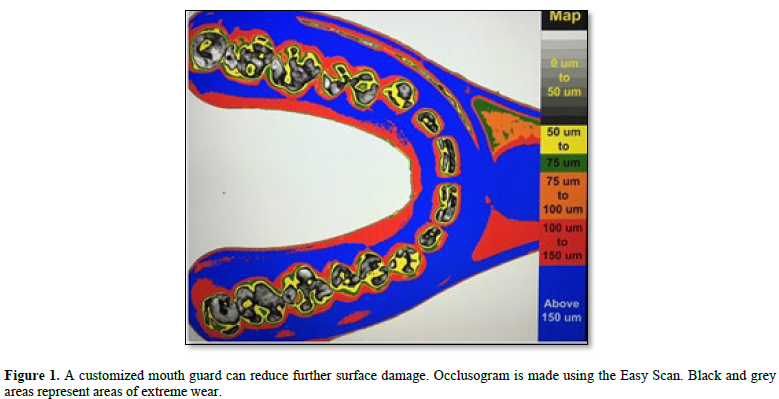
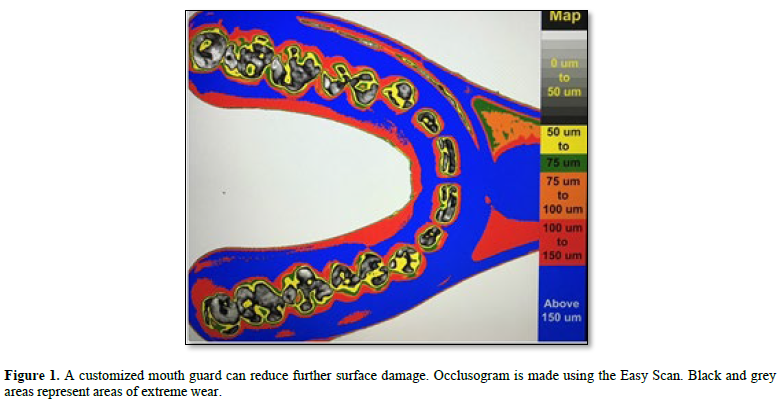
It is over one hundred years old and can be executed digitally. The CAD software uses the jaw movements to find occlusal defects and construct an anatomy for the surface. The upper and lower surfaces are scanned. An intra oral scanner records the sculpted wax bite in the mouth and saves it as an STL. A soft ware that has an open STL system may help in designing the surface areas. An occlusal surface is crafted to fit the patient. The mouth guard becomes a therapeutic appliance to be worn as directed. Store bought mouth/bite guards are destructive because they do not fit a patient’s occlusion. Prescribing a mouth guard as a therapeutic device is a viable treatment since there is no cure for bruxing (Figure 1).
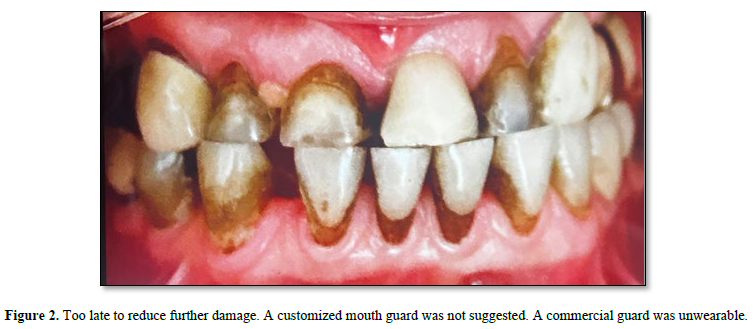
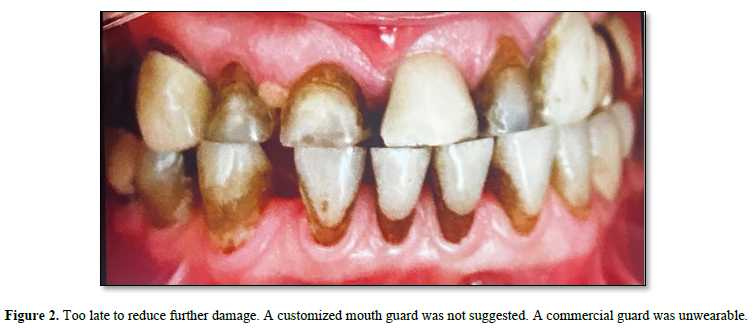
Severe bruxing not only affects the teeth but can also alter head and neck positioning [10] (Figure 2). A therapeutic mouth guard can temporarily increase lost vertical dimension and reduce grinding. Periodic dental visits are required to adjust or replace an appliance. Mouth guards do not last forever. Occlusal treatments may vary. Mouth guards are prescribed, individualized, and clinically maintained by a dental professional. The working occlusion is no longer destructive. It has stabilized.

No Files Found


Internationally Accepted
Share Your Publication :