
-
Publish Your Research/Review Articles in our High Quality Journal for just USD $99*+Taxes( *T&C Apply)
Offer Ends On
Publish Your Research/Review Articles in our High Quality Journal for just USD $99*+Taxes( *T&C Apply)
Offer Ends On
Philip L Millstein DMD, MS*
Corresponding Author: Philip L Millstein, Department of Restorative Dentistry, Harvard School of Dental Medicine, Boston, Massachusetts, USA.
Received: October 10, 2026 ; Revised: October 14, 2026 ; Accepted: October 15, 2026 ; Available Online: October 16, 2026
Citation: Millstein PL. (2026) The Need for Static and Functional Occlusal Records. J Oral Health Dent Res, 5(3): 1-3.
Copyrights: ©2026 Millstein PL. This is an open-access article distributed under the terms of the Creative Commons Attribution License, which permits unrestricted use, distribution, and reproduction in any medium, provided the original author and source are credited.
Views & Citations
Likes & Shares
Permanent records are used to compare past events to the present. Records of the occlusion do not exist. The need for permanent records is self-evident.
Keywords: Occlusion, Intensity, Bruxism, Contact.
Static occlusion defines tooth contact; functional occlusion defines a sliding tooth contact [1]. Surface areas and contact locations differ for patients [2]. Bruxism is a neurological disease where rubbing and intensity of contact prevail [3]. The force of intense contact is absorbed by the teeth, the supporting periodontal housing, and the underlying bone [4]. Implants do not have a periodontium [5]. The resultant force is distributed downward and outwards into the surrounding bone. Touch with implants is minimal. Biting forces are variable [6]. Intense contact can weaken implant stability and destabilize a dentition. Teeth and implants exist in a dynamic state of micro movement. Implant restorations are usually under occluded so that no clinical adjustments are required [7]. A clinician must locate and adjust outstanding tooth contact areas one by one to achieve occlusal stability. The choice of a specific marking indicator dictates how much tooth material is removed [8]. The adjustment procedure can slightly reduce the existing vertical dimension. People unconsciously grind their teeth to even out their occlusion. Under occluded restorations eliminate selected occlusal stops which support the posterior occlusion [9]. Intra oral contacts shift. Bruxing is an iterative process which can be assessed visually using contact marking indicators. There are no permanent occlusal contact records. Before engaging in implant restoration it is best to adjust the occlusion. Implant restorations are successful but the affect such restorations have on the adjacent teeth and restorations is unknown.
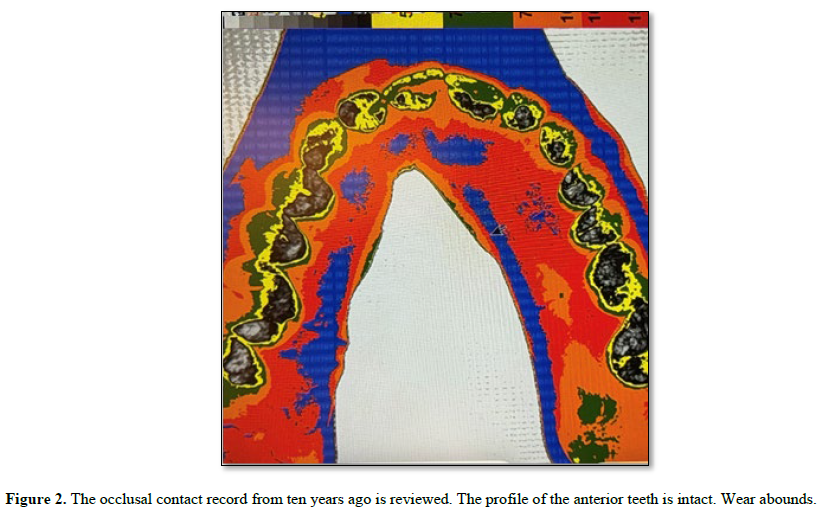
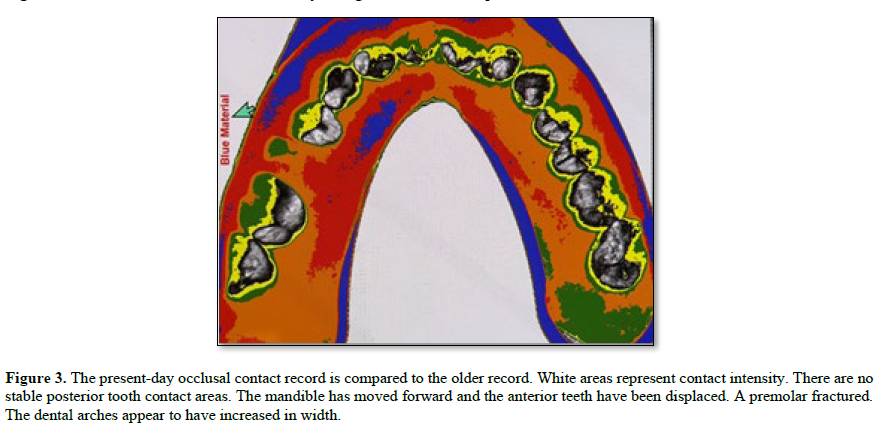
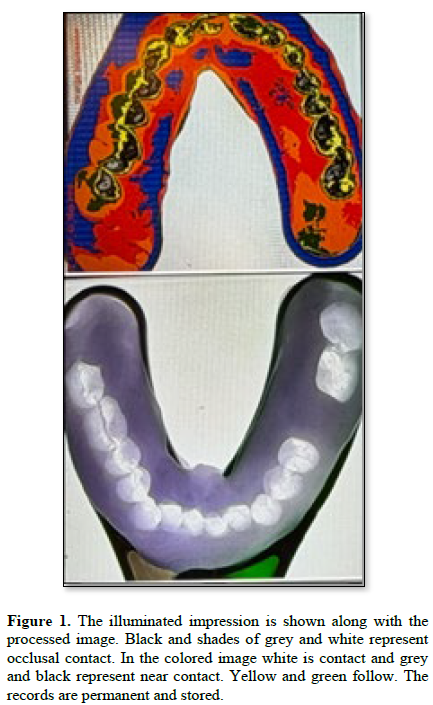
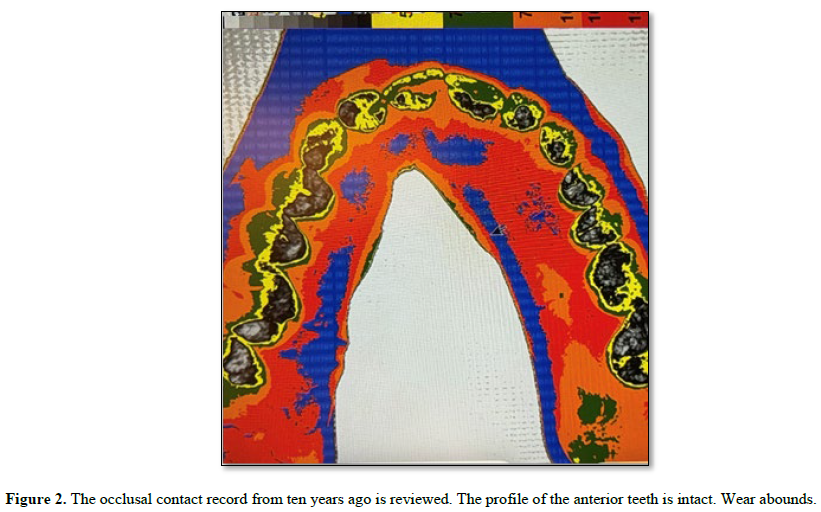
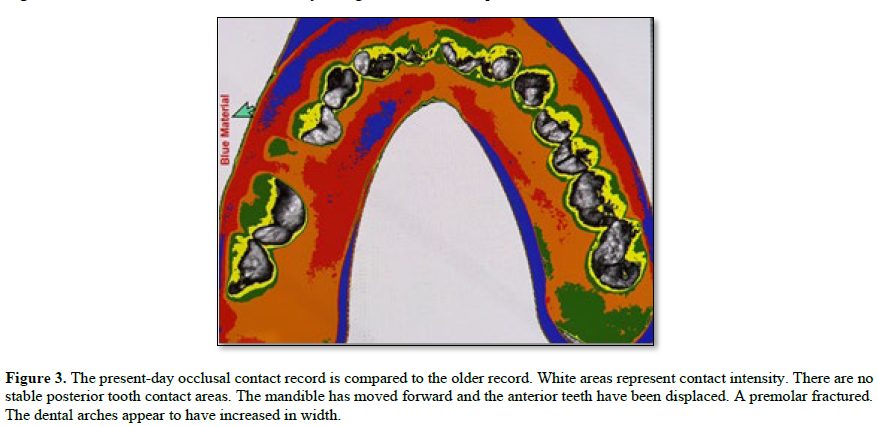
Figures 1, 2 and 3 are of the same patient. The records were made ten years apart (Figure 2). The physical health of the patient remains good. Medications are not required. The patient has four longstanding implants along with failed crowns and root canals. An impression was made using a triple tray and a non set silicone material which can record slight movement [10]. The impression was immediately processed using the Easy Scan which comprises a light box, mounted camera and an image analysis program.The resultant colored images of occlusal contact are shown on the computer screen (Figure 3).
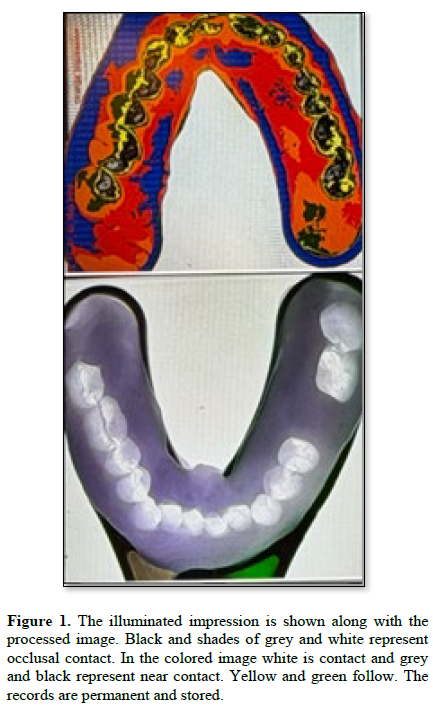
The ongoing damaging affects of grinding and clenching are clearly visible. The surface damage is severe and irreversible. The need for permanent records and periodic clinical evaluation is self-evident.

No Files Found


Internationally Accepted
Share Your Publication :