
-
Publish Your Research/Review Articles in our High Quality Journal for just USD $99*+Taxes( *T&C Apply)
Offer Ends On
Publish Your Research/Review Articles in our High Quality Journal for just USD $99*+Taxes( *T&C Apply)
Offer Ends On
Philip L Millstein DMD, MS*
Corresponding Author: Philip L Millstein, Department of Restorative Dentistry, Harvard School of Dental Medicine, Boston, Massachusetts, USA.
Received: August 11, 2026 ; Revised: August 16, 2026 ; Accepted: August 17, 2026 ; Available Online: August 18, 2026
Citation: Millstein PL. (2026) The Significance of Occlusal Contact. J Oral Health Dent Res, 5(3): 1-3.
Copyrights: ©2026 Millstein PL. This is an open-access article distributed under the terms of the Creative Commons Attribution License, which permits unrestricted use, distribution, and reproduction in any medium, provided the original author and source are credited.
Views & Citations
Likes & Shares
An occlusal contact represents an end point and a starting place for occlusal function. It’s value is generally underestimated and it’s function is ignored. Multiple occlusal contacts working together control our physiological health.
Keywords: Occlusal contact, Occlusion, Malocclusion, Bruxism, Vertical Dimension.
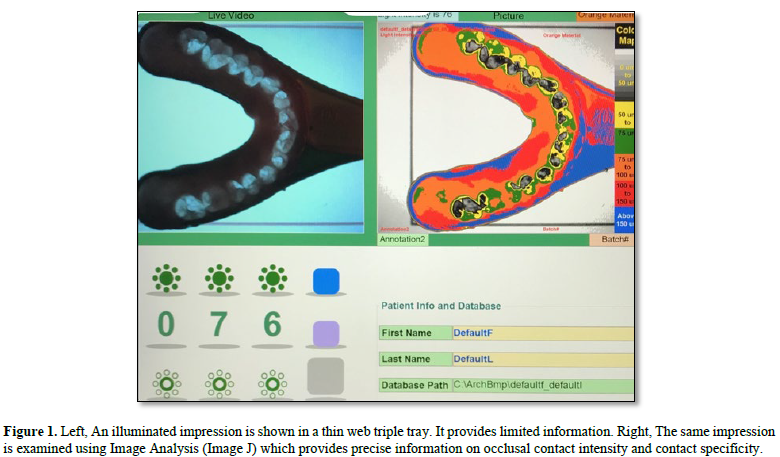
What does an occlusal contact represent? (1). It represents occlusal contact stability. The contact profile is dictated by mandibular movement. The smashing and clashing of opposing occlusal surfaces in a bruxer tells a story of contact instability which may connect to our everyday health and well being (2). The dimensions of occlusal health and destruction vary amongst individuals but the basic body mechanics remain the same. Occlusal health can deteriorate if left unattended (3). Occlusal contact imbalance can lead to physical changes that are associated with joint and muscle pain (4). Occlusal wear can be assessed by measuring or visualizing worn surface areas (5). The condylar housing adjusts. as occlusal contact or contacts malfunction. When a joint is worn the surface area of a working occlusal contact reflects the worn surface of the joint (6). As an occlusal contact expands there is a positional change in movement of the condyle or supporting cartilage which is avascular. The condylar cartilage cannot resurface or regenerate. How does a joint work efficiently if the teeth associated with it don’t occlude in harmony? The joint must adapt along with the surrounding facial structures to a maladaptive position. The disharmony and imbalance of an occlusion can be seen in a translucent bite impression which is made in a triple tray Figure 1.
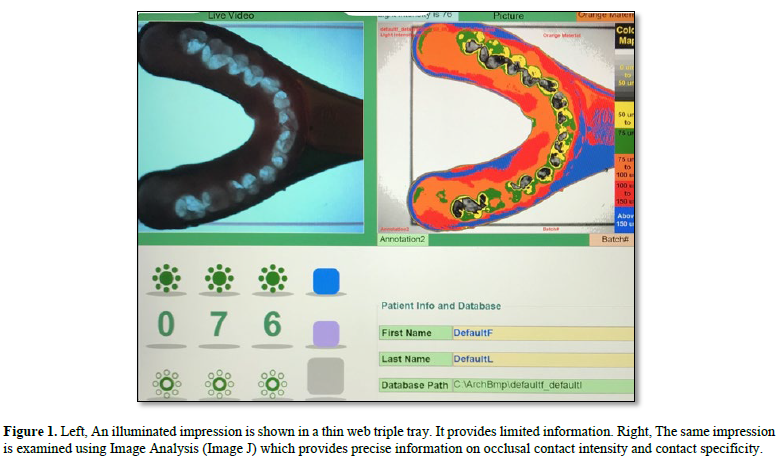
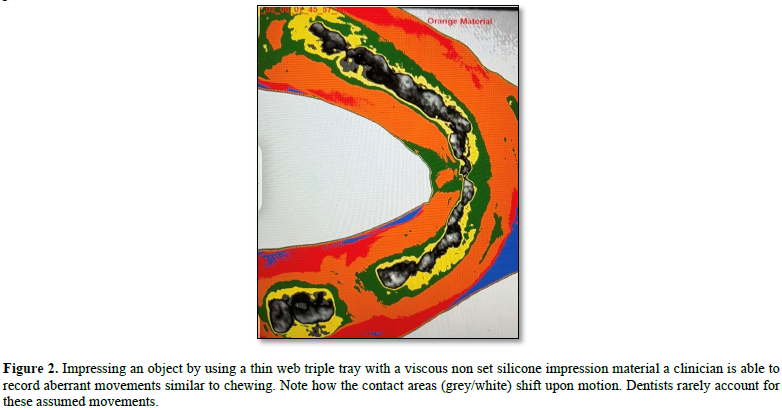
All white areas are contact areas. This is a simple inexpensive procedure where an office person photographs an illuminated impression using an I phone camera. A permanent record is made. Careful examination and a treatment plan are required before any occlusal adjustment or treatment is instituted. (7). An overall view is suggested. Figure 2.
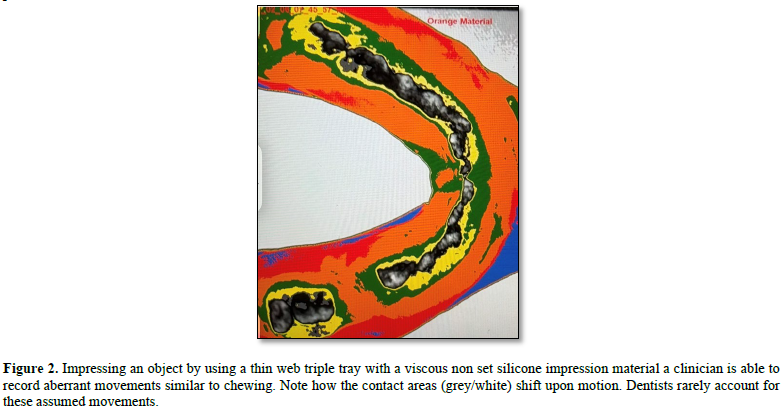
The occlusal profile is interpreted using image analysis (8). The results are visual and easy to read. Black and grey/white colors signify intensity of bite and contact. Bite intensity can be assessed visually (9). There is little need to measure force and record it in numbers. An unbalanced jaw will affect joint movement (10). Chewing activity can be replicated using a non-stick viscous silicone impression material. The occlusal ramifications of chronic joint disarticulation become visible in the occlusal recording. MODJAW is a mandibular movement measuring device which records mandibular movements related to the occlusion but it does not record information on the intimate relationship of occlusal contact to mandibular movement (11). Occlusal contact is the position where mandibular movement begins and terminates. Gnathologists understood that movement, and the occlusion, (occlusal contact) were connected (12). Multiple occlusal contacts position the mandible to the opposing maxilla. Occlusal contact dictates movement. Contact and movement are connected. They work in unison. As the occlusion shifts the temporomandibular joint (TMJ) changes position and adjusts along with the adjacent facial structures (13). There is always an accompanying neural accommodation to a positional change. Vertical dimension is altered. Occlusal change differs amongst individuals. Choice of food is visual but the idea of eating with TMJ disharmony determines our choices. If you cannot chew you cannot digest the food or properly swallow. We cannot swallow like sharks and eat and digest whole portions of food without chewing (14). A cyclist cannot ride with tires that are unbalanced. The bicycle frame will shake until the tires are balanced and the wheels aligned. The mandible cannot realign and gain balance without professional help. The joint is a functioning unknown. It’s physiological correlation to the occlusion is basically unknown. Basic and clinical research of the teeth, jaws and chewing mechanism is essential to provide a meaningful clinical guide for life long oral, occlusal and physical health. Physical health or pain cannot be explained away with simple answers. The underlying causes are often visible if we dare to look.

No Files Found


Internationally Accepted
Share Your Publication :