
-
Publish Your Research/Review Articles in our High Quality Journal for just USD $99*+Taxes( *T&C Apply)
Offer Ends On
Publish Your Research/Review Articles in our High Quality Journal for just USD $99*+Taxes( *T&C Apply)
Offer Ends On
Bruno Viana Reis*
Corresponding Author: Bruno Viana Reis, Unique Dental, 90-97 Cork Street, Dublin, Ireland.
Received: August 02, 2026 ; Revised: August 04, 2026 ; Accepted: August 05, 2026 ; Available Online: August 06, 2026
Citation: Reis BV. (2026) Association Between Bilateral Posterior Occlusal Contact Symmetry and Static Postural Stability in Healthy Adults: A Cross-Sectional Baropodometric Study. J Oral Health Dent Res, 5(3): 1-7. https://doi.org/10.5281/zenodo.21918760
Copyrights: ©2026 Reis BV. This is an open-access article distributed under the terms of the Creative Commons Attribution License, which permits unrestricted use, distribution, and reproduction in any medium, provided the original author and source are credited.
Views & Citations
Likes & Shares
Statement of problem: Evidence concerning the relationship between dental occlusion and postural stability is conflicting, and functional occlusal-contact symmetry has been investigated less frequently than morphologic classifications.
Purpose: The purpose of this cross-sectional study was to determine whether the change in static postural sway from mandibular rest to maximum intercuspation differed between adults with greater and lower bilateral posterior occlusal-contact symmetry under eyes-open and eyes-closed conditions.
Material and methods: Thirty healthy adults (17 women and 13 men; mean age, 35±10 years) underwent an occlusal assessment and static baropodometric evaluation. Participants were classified as having greater symmetry (Group 1: 2 to 4 simultaneous bilateral posterior contact pairs; n=15) or lower symmetry (Group 2: 0 or 1 bilateral contact pair; n=15). Total postural sway area was recorded during mandibular rest and maximum intercuspation with the eyes open and closed. Separate 2-way mixed-model ANOVAs were performed for each visual condition, with occlusal-contact group as the between-participant factor and mandibular position as the within-participant factor. The group-by-position interaction was the primary effect.
Results: The group-by-mandibular-position interaction was not significant with the eyes open (F (1,28) =2.55, P=.122, partial η²=.083). With the eyes closed, the interaction was significant (F (1,28) =19.18, P<.001, partial η²=.407). From rest to maximum intercuspation, the greater-symmetry group showed a mean reduction in sway area of 40.76 cm², whereas the lower-symmetry group showed a mean increase of 34.93 cm². The between-group difference in change was 75.70 cm² (95% confidence interval, 40.29 to 111.10 cm²; P<.001).
Conclusions: Under eyes-closed conditions, the effect of mandibular position on static postural sway differed according to bilateral posterior occlusal-contact symmetry. No corresponding interaction was identified with the eyes open. These findings indicate an association under reduced visual input but do not establish causality or a therapeutic effect of occlusal intervention.
CLINICAL IMPLICATIONS
The relationship between dental occlusion and whole-body posture remains controversial, with heterogeneous findings across study designs and outcome measures. [4-6,25,31,35] In this sample, the change in postural sway from mandibular rest to maximum intercuspation differed according to bilateral posterior occlusal-contact symmetry only when visual input was absent. Stable bilateral posterior contacts remain an appropriate conventional objective of prosthodontic rehabilitation; however, these findings do not support occlusal intervention as a treatment for postural disorders.
INTRODUCTION
The maintenance of upright posture depends on continuous integration of visual, vestibular, and somatosensory information by the central nervous system. [1,2] The stomatognathic system contributes somatosensory input through periodontal mechanoreceptors, temporomandibular-joint receptors, and muscle spindles within the masticatory system. [3,15,20,21] Trigeminal afferents communicate with brainstem, vestibular, cerebellar, and cervical motor networks, providing a biologically plausible pathway through which changes in orofacial sensory input could modulate postural regulation. [15,19,20]
Despite this biological plausibility, investigations of dental occlusion and posture have produced inconsistent findings. [4-10,25-27,31-33,35]
Methodological heterogeneity is substantial and includes differences in participant selection, postural tasks, acquisition duration, visual conditions, mandibular positions, and the criteria used to classify occlusion. [4-6,25,27] Many studies have emphasized Angle classification, temporomandibular disorders, or experimentally altered mandibular positions rather than the functional symmetry of simultaneous posterior contacts. [5,6,25,34]
The sensory-reweighting model proposes that the central nervous system dynamically changes the relative contribution of sensory inputs according to their availability and reliability. [16-18] When visual input is removed, greater reliance is placed on vestibular and somatosensory information. [17,18] Consequently, any contribution from occlusal proprioception may become more apparent under eyes-closed or otherwise challenging postural conditions. [8,27,28]
Electromyographic investigations have demonstrated functional coupling between masticatory activity and cervical or more distant postural muscles. [10,22,23] Other studies have reported changes in postural measures after modification of mandibular position, posterior contact area, or occlusal balance. [8-14,24,29,30] However, comparatively few investigations have classified healthy adults according to the symmetry of naturally occurring simultaneous posterior contacts and examined the within-participant change between mandibular rest and maximum intercuspation. [24,27]
Therefore, the purpose of this cross-sectional study was to determine whether the change in static postural sway from mandibular rest to maximum intercuspation differed between adults with greater and lower bilateral posterior occlusal-contact symmetry under eyes-open and eyes-closed conditions. The null hypothesis was that the rest-to-maximum-intercuspation change in total sway area would not differ between occlusal-contact groups under either visual condition.
MATERIAL AND METHODS
This cross-sectional observational study was conducted in accordance with the Declaration of Helsinki and was approved by the Research Ethics Committee of the Clementino Fraga Filho University Hospital (HUCFF; Protocol No. 089/09) on September 3, 2009. Thirty volunteers aged 18 to 60 years were recruited through notices placed in the otorhinolaryngology outpatient department and the integrated dental clinic. The sample comprised 17 women and 13 men (mean age, 35±10 years). Group 1 included 9 women and 6 men, and Group 2 included 8 women and 7 men. Participants were required to have a complete dentition through the second molars, although isolated individual crowns were permitted, and to be able to stand unsupported and follow the study instructions. Exclusion criteria were removable partial or complete dentures, fixed bridges or extensive prosthetic restorations, active orthodontic treatment, diabetes mellitus, neurologic disease, limiting or deforming musculoskeletal disease, a history of otologic, orthopedic, or neurosurgical procedures, dizziness or imbalance, inability to maintain an unsupported standing position, and use of benzodiazepine or anticonvulsant medication.
Occlusal Assessment
A single calibrated examiner evaluated posterior occlusal contacts in maximum intercuspation using 12-μm Arti-Fol® articulating film (Bausch). Participants were seated with lumbar support, their feet on the floor, and their knees flexed to approximately 90 degrees. They were instructed to close slowly and progressively into maximum intercuspation. Simultaneous contacts were assessed separately for homologous pairs of first premolars, second premolars, first molars, and second molars. A contact pair was classified as bilateral when homologous right and left posterior tooth pairs contacted simultaneously. Participants were allocated to Group 1 (greater symmetry: 2 to 4 bilateral contact pairs) or Group 2 (lower symmetry: 0 or 1 bilateral contact pair).
Postural Analysis
Static postural sway was recorded using a DIASU computerized baropodometric platform equipped with 12 800 pressure-sensitive electrodes over an 80×40-cm surface and a standardized foot-positioning guide. The platform was positioned 2 m from a wall in a quiet, private room. Participants stood barefoot in light clothing, with the arms relaxed, the feet slightly separated, and the feet oriented at approximately 30 degrees according to the positioning guide. Each recording lasted 30 seconds. Four conditions were evaluated:
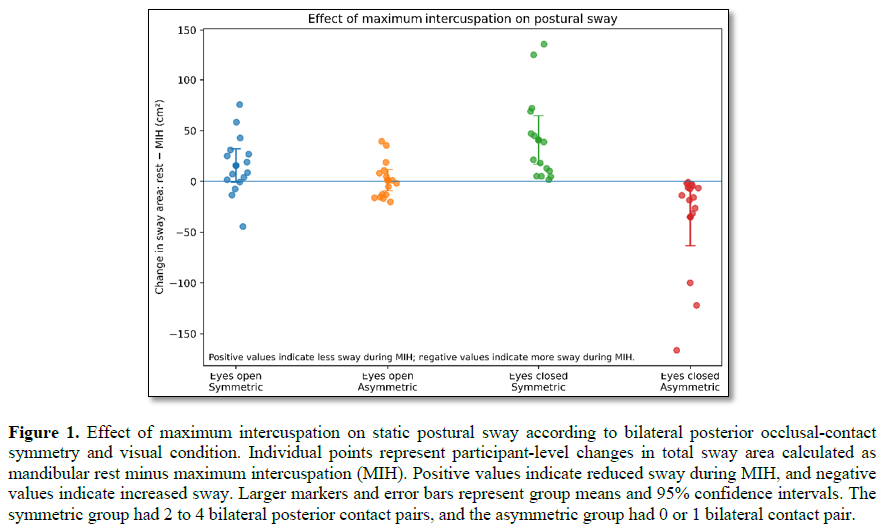
The primary outcome was the total postural sway area recorded by the baropodometric platform and expressed in cm². For descriptive change analyses, the MIH value was subtracted from the mandibular-rest value. Positive values therefore indicated reduced sway during MIH, whereas negative values indicated increased sway during MIH.
Statistical Analysis
The raw data were reanalyzed for the present report using Python 3.13 (Python Software Foundation), SciPy 1.17, and statsmodels 0.14.6. Separate 2-way mixed-model ANOVAs were performed for the eyes-open and eyes-closed conditions. Occlusal-contact group (greater or lower symmetry) was the between-participant factor, and mandibular position (rest or MIH) was the within-participant factor. The group-by-mandibular-position interaction was the primary effect of interest. Partial η² was reported as the effect-size estimate. Because 2 primary interaction tests were performed, statistical significance for these tests was set at α=.025. Within-group paired t tests and 95% confidence intervals were reported as secondary descriptive analyses. Because the eyes-closed change scores were non-normally distributed, Mann-Whitney U and Wilcoxon signed-rank tests were performed as sensitivity analyses.
RESULTS
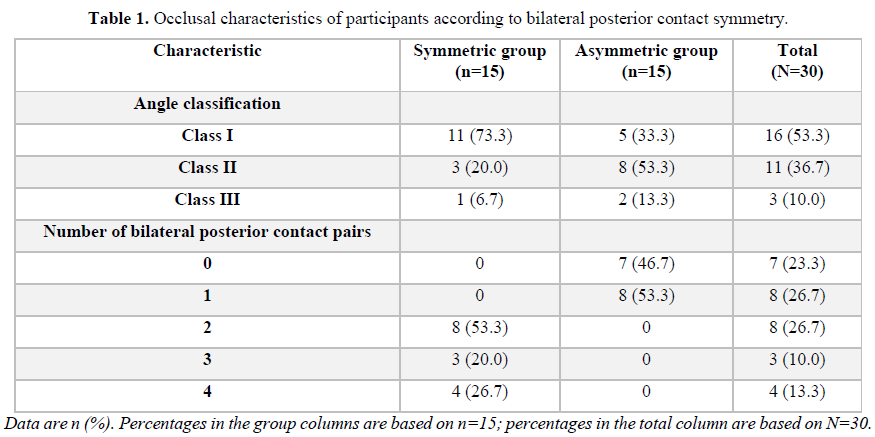
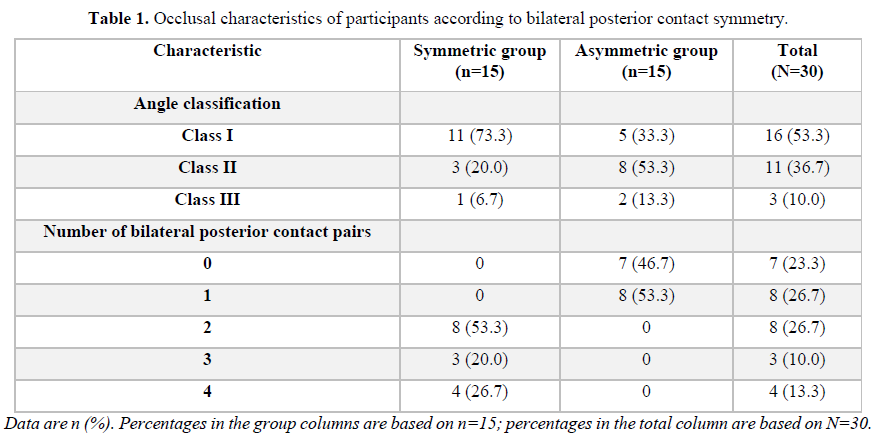
All 30 participants completed the protocol. The greater-symmetry group comprised 9 women and 6 men, and the lower-symmetry group comprised 8 women and 7 men. Angle and bilateral posterior-contact distributions are presented in Table 1. Angle Class I was observed in 11 participants in Group 1 and 5 in Group 2; Class II in 3 and 8 participants, respectively; and Class III in 1 and 2 participants, respectively.
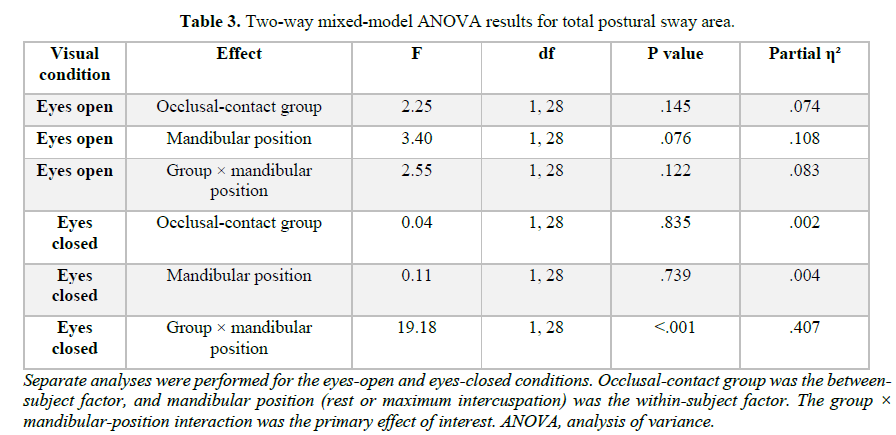
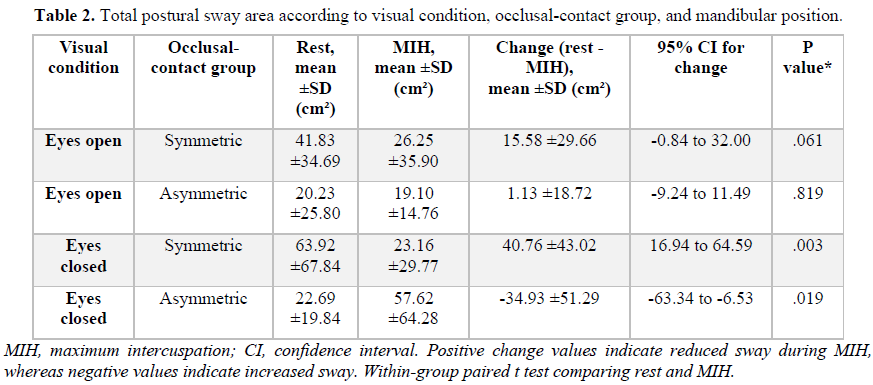
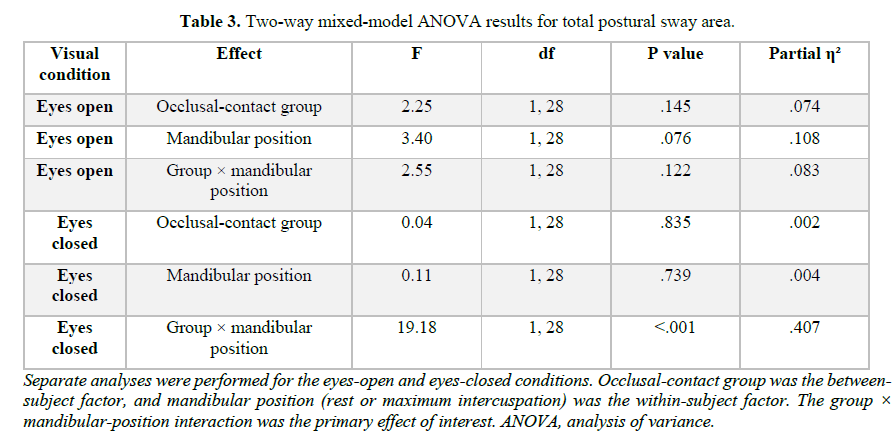
Descriptive sway-area values are presented in Table 2, and the mixed-model ANOVA results are presented in Table 3. Under eyes-open conditions, neither the main effect of occlusal-contact group (F(1,28)=2.25, P=.145, partial η²=.074) nor the main effect of mandibular position (F(1,28)=3.40, P=.076, partial η²=.108) was significant. The group-by-mandibular-position interaction was also not significant (F(1,28)=2.55, P=.122, partial η²=.083). The mean rest-to-MIH reduction was 15.58 cm² in Group 1 and 1.13 cm² in Group 2.
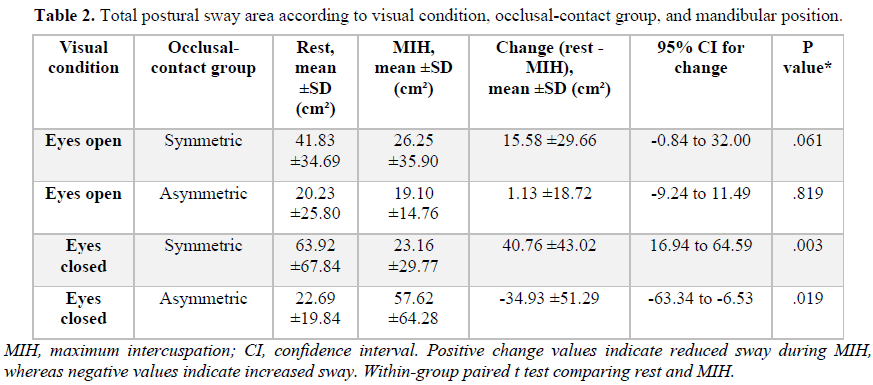
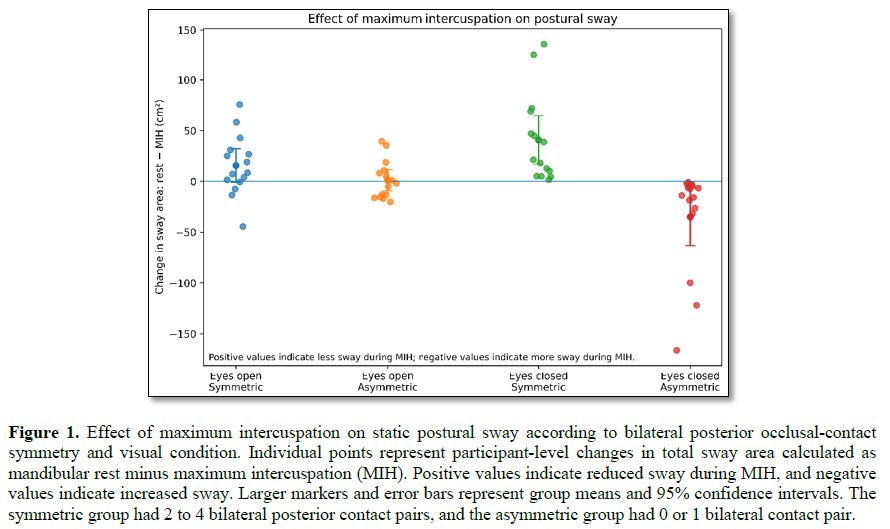
Under eyes-closed conditions, the main effects of group (F(1,28)=0.04, P=.835, partial η²=.002) and mandibular position (F(1,28)=0.11, P=.739, partial η²=.004) were not significant; however, the group-by-mandibular-position interaction was significant (F(1,28)=19.18, P<.001, partial η²=.407). Group 1 showed a mean reduction in sway area of 40.76 cm² from rest to MIH (95% confidence interval [CI], 16.94 to 64.59 cm²; P=.003), whereas Group 2 showed a mean increase of 34.93 cm² (95% CI, 6.53 to 63.34 cm²; P=.019). The between-group difference in change was 75.70 cm² (95% CI, 40.29 to 111.10 cm²; P<.001; Hedges g=1.56). Individual change scores and group means with 95% CIs are shown in Figure 1. Sensitivity analyses supported the primary finding: the between-group difference in eyes-closed change scores remained significant with the Mann-Whitney U test (P<.001), whereas the eyes-open comparison was not significant (P=.089).
DISCUSSION
The null hypothesis was rejected for the eyes-closed condition but not for the eyes-open condition. The principal finding was a group-by-mandibular-position interaction rather than a general main effect of occlusal-contact group. When vision was absent, participants with greater bilateral posterior contact symmetry generally showed reduced sway during maximum intercuspation, whereas those with lower symmetry showed increased sway. With the eyes open, the rest-to-MIH change did not differ significantly between groups.
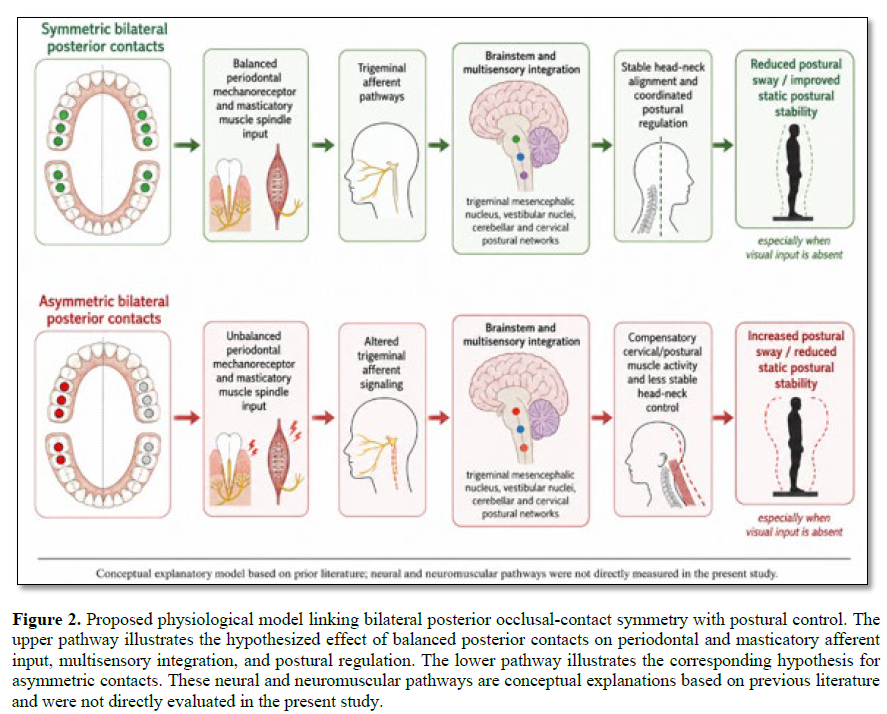
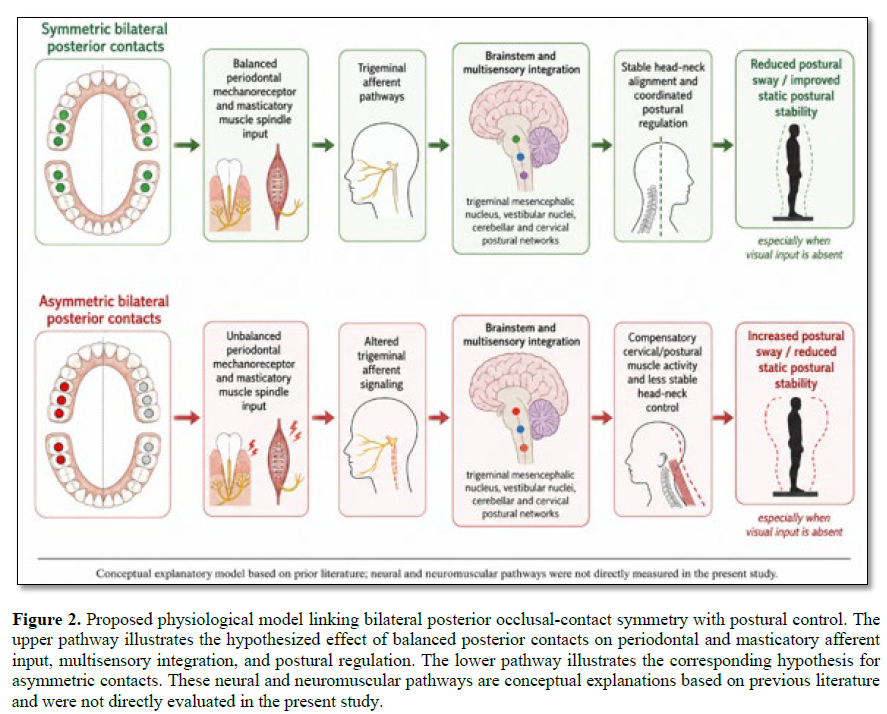
A cautious physiological interpretation is that visual input may compensate for, or reduce the relative weighting of, stomatognathic somatosensory information during quiet standing. When visual information is removed, trigeminal, vestibular, and other somatosensory inputs may assume greater relative importance.15-21,27 Symmetric posterior contacts could provide more balanced periodontal and masticatory afferent input than markedly asymmetric contacts; however, neural activity, vestibular function, and cervical or postural muscle activity were not measured in this study. Figure 2 therefore presents a conceptual explanatory model rather than a mechanism demonstrated by the data. [3,19,20,31]
The present findings are compatible with reports that mandibular position, posterior contact area, or experimentally improved occlusal balance can alter postural measures, particularly under more demanding sensory or motor conditions. [8-14,24,27,29,30] They also differ from studies that found no clinically meaningful relationship between occlusion and posture or only small, inconsistent associations. [4-7,25,26,32,33,35] These differences reinforce the importance of the selected occlusal variable. Angle classification describes anteroposterior dental relationships but does not directly quantify the timing and bilateral symmetry of posterior contacts. The present study specifically examined a functional contact criterion, although the imbalance in Angle classifications between groups remains a potential confounder.
From a prosthodontic perspective, stable and bilaterally distributed posterior contacts are already conventional functional objectives. The current results suggest that such symmetry may also be associated with the postural response to maximum intercuspation when visual input is absent. Nevertheless, the study does not demonstrate that occlusal adjustment improves postural health, prevents falls, or treats a postural disorder. Occlusal intervention should not be prescribed for postural complaints on the basis of these findings, particularly because postural control is multifactorial and the broader literature remains inconsistent. [4,5,25,31,35]
Several limitations should be considered. The cross-sectional design precludes causal inference, and the sample was small and limited to healthy adults. Only one 30-second recording was available for each condition, and the sequence of the four conditions was not documented as randomized. Occlusal symmetry was classified clinically with articulating film rather than quantified digitally, and no electromyographic, vestibular, or cervical kinematic measurements were obtained. Age was available only for the total sample, and the different Angle-class distributions between groups may have confounded the association. The sway data included high values and non-normal eyes-closed change distributions, although nonparametric sensitivity analyses supported the principal interaction. Finally, the complete separation in the direction of eyes-closed change within this sample should be replicated in larger, prospectively designed cohorts.
CONCLUSIONS
Within the limitations of this cross-sectional study, the following conclusions were drawn:
3. The findings identify an association under reduced visual input but do not establish a causal mechanism or support occlusal intervention as treatment for postural disorders.
No Files Found


Internationally Accepted
Share Your Publication :