
-
Publish Your Research/Review Articles in our High Quality Journal for just USD $99*+Taxes( *T&C Apply)
Offer Ends On
Publish Your Research/Review Articles in our High Quality Journal for just USD $99*+Taxes( *T&C Apply)
Offer Ends On
Philip L Millstein DMD, MS*
Corresponding Author: Philip L Millstein, Department of Restorative Dentistry, Harvard School of Dental Medicine, Boston, Massachusetts, USA.
Received: July 23, 2026 ; Revised: July 25, 2026 ; Accepted: July 27, 2026 ; Available Online: July 28, 2026
Citation: Millstein PL. (2026) An Occlusal Contact Baseline. J Oral Health Dent Res, 5(3): 1-3.
Copyrights: ©2026 Millstein PL. This is an open-access article distributed under the terms of the Creative Commons Attribution License, which permits unrestricted use, distribution, and reproduction in any medium, provided the original author and source are credited.
Views & Citations
Likes & Shares
This paper questions the veracity of occlusal contact recordings made using electronic force measuring devices. Positioning and location of occlusal contacts are questioned.
Keywords: Occlusal contact, Electronic measures, Contact location, Contact area.
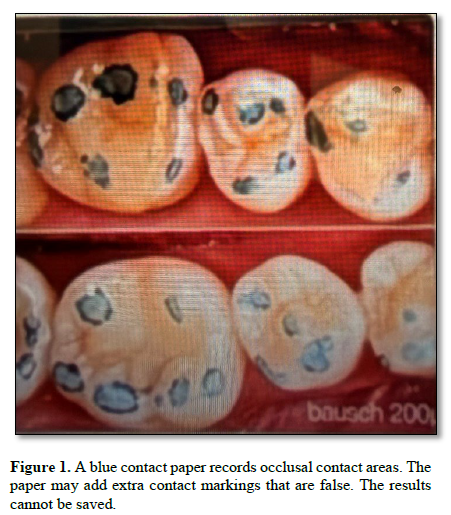
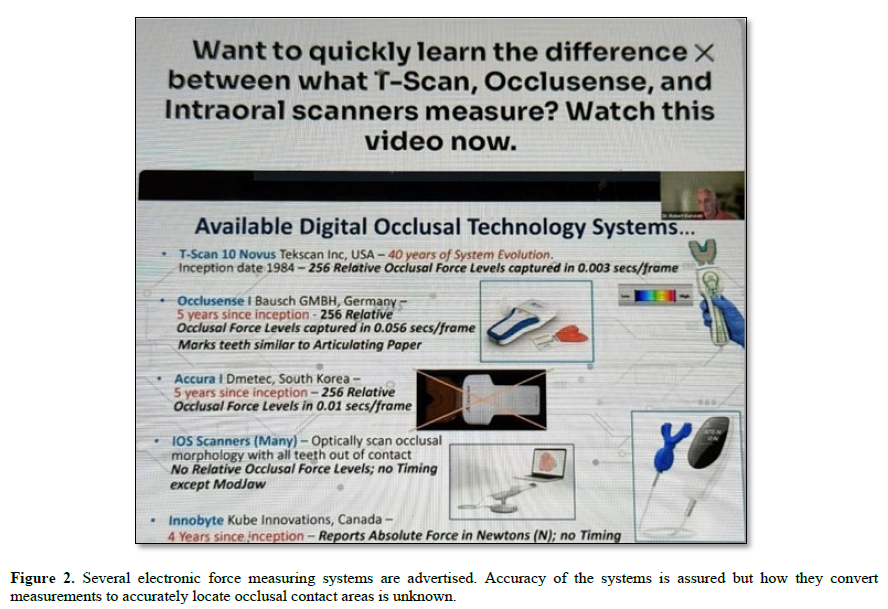
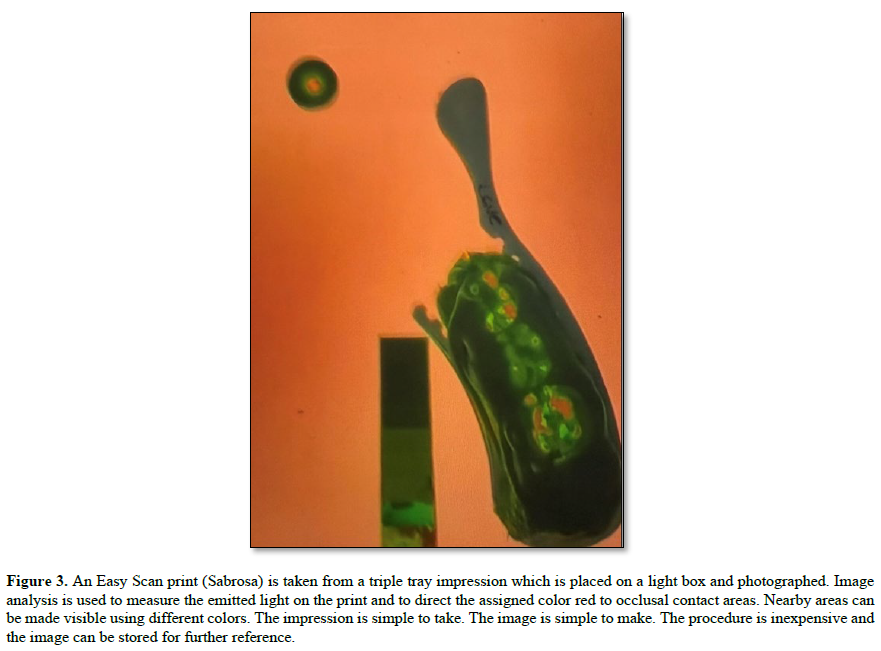
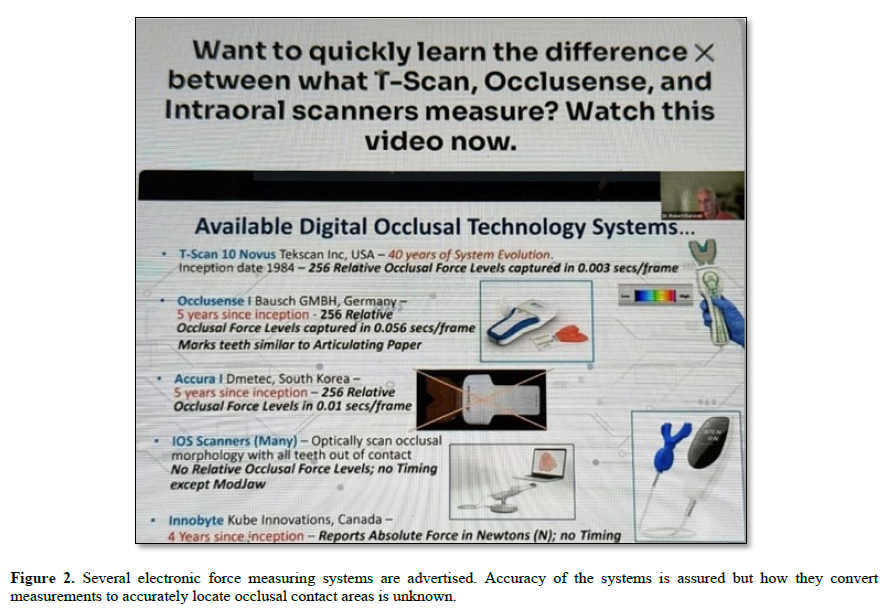
It is important upon routine examination to create an occlusal contact profile. The profile includes the contact areas where the dynamics of an occluding dentition takes place. It is the individual contacts that support the jaw position and ultimately the occlusion (1). Prevention is built upon early intervention (2). Shifts in occlusal contact areas may signify change. Dentists do not record the status of occlusal contact areas in the working occlusion. Instead electronic systems are used to record and store occlusal force points which are converted into simulated occlusal contact areas (3). Force is not contact (4). Force areas which include intensity of contact/force are recorded on a universal grid which is arch shaped and includes areas that signify teeth (5). Closing force data is measured from a 60 to 100 micron thick plastic wafer which contains numerous receptors (6). The wafer impedes full closure because it is relatively thick and semi pliant. Locations of actual tooth contacts may not be precise (7). Bilateral balance of the jaws signifies occlusal health. Electronic systems that measure force are used to record a balanced occlusion (8). The teeth in the dentitions that underlie the recording wafer must be adjusted in order to achieve bilateral balance on the wafer. Adding or subtracting surface areas from tooth structure is required. Essential occlusal contacts may be lost upon removal of surface areas (9). The damage is irreversible. This may lead to eventual bite collapse and mandibular displacement (10). Are the teeth and jaws in bilateral balance? Allayed with these devices is measurement of the speed of disclusion (11). The faster the separation of the working occlusion, as measured in milliseconds, the better the functioning occlusion? The force measuring devices have not been proven to accurately measure, locate and record occlusal contact. They measure closing forces and locate them on a universally segmented arch form that simulates occlusal contact locations. Many clinicians rely upon these electronic systems to verify their clinical results. There is no scientific information to prove that what clinicians see on the wafer is what they get without the wafer. Presently there is no way to test these systems for clinical accuracy and reliability. Clinical judgements vary. Standards are required for evaluation. Presently there are no standards. Physicians compare blood pressure readings over time. There is a baseline. Dentists can not share occlusal contact information because there is no baseline. Permanent baseline records of occlusal contact are required to monitor occlusal health.
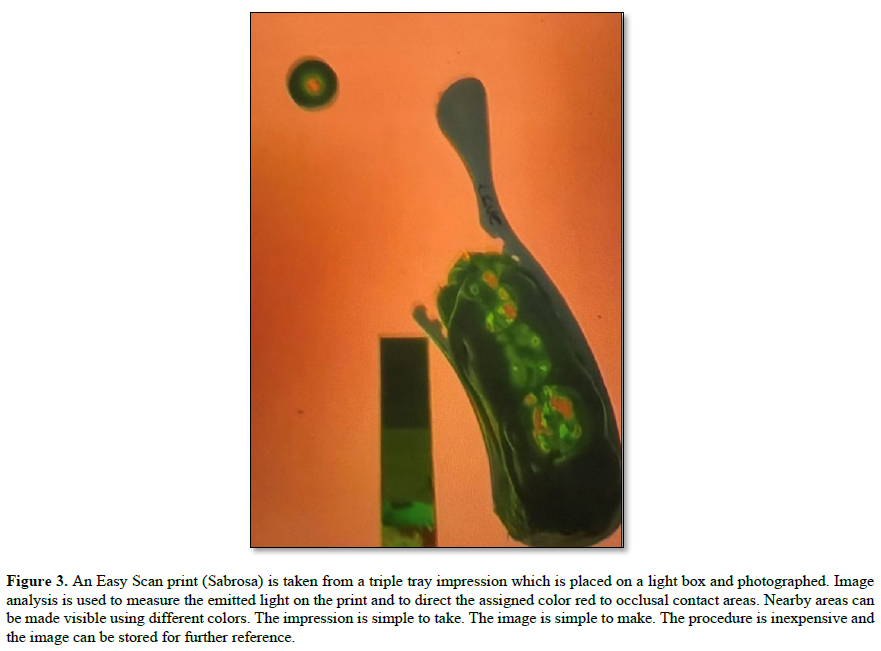
The figures demonstrate various means to monitor occlusal contact.

No Files Found


Internationally Accepted
Share Your Publication :